Major Arcana
Meaning of the 22 major arcana of Tarot de Marseille
The 22 major arcana form the symbolic heart of Tarot de Marseille. They are the cards most often found at the center of learning, interpretive practice and in-depth tarot study. They do not merely describe events: they stage major human dynamics, passages, crises, choices, fulfillments, blockages and transformations.
Studying the major arcana does not mean memorizing a simple list of keywords. It means entering a true symbolic language. Each card has its own structure, atmosphere, internal logic, place within the deck and way of resonating in a spread.
On this page, you will find a clear, serious and encyclopedic presentation of the 22 major arcana, with a concise synthesis for each one and a link to its detailed card page. This approach gives you both a global view and precise access to each card.
What are the major arcana?
The major arcana form the central series of Tarot de Marseille. They run from The Magician to The World, with The Fool added as a singular figure that does not entirely fit into the usual numerical logic. These 22 cards carry the great themes of tarot: beginning, inwardness, creation, power, transmission, choice, movement, balance, withdrawal, transformation, circulation, desire, crisis, light, rebirth and fulfillment.
One may say that they represent the great structures of human experience. Where the minor arcana often specify the registers of everyday life, the majors draw deeper lines of force. They do not speak only of what happens, but of the symbolic quality of what is at stake.
This is why they occupy such an important place in the study of tarot. They make it possible to understand the overall logic of the deck and to enter a deeper reading than the mere description of events.
The 22 major arcana, card by card
Here is the complete list of the 22 major arcana of Tarot de Marseille. Each card below offers a clear synthesis of its main meaning and points to its detailed interpretation.
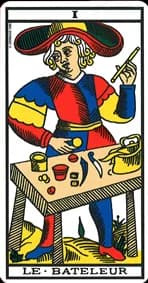
Arcane I
The Magician
Beginning, initiative, potential, moving into action.
The Magician opens the sequence of the major arcana. He speaks of momentum, beginning, trial, learning and the capacity to enter experience. He does not yet guarantee fulfillment, but he points to the real possibility of a start.
Read the full card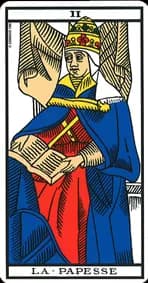
Arcane II
The High Priestess
Inwardness, knowledge, gestation, silence, maturation.
The High Priestess represents reserve, inward knowledge, slow maturation and silent depth. She invites you not to force time, to read beneath the surface and to let form what is not yet ready to show itself.
Read the full card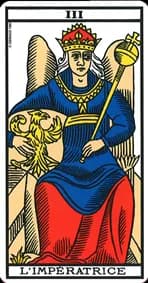
Arcane III
The Empress
Creative intelligence, expression, liveliness, conception.
The Empress sets thought, language, creation and symbolic fertility in motion. She speaks of shaping, active intelligence, radiance and the capacity to conceive and then express.
Read the full card
Arcane IV
The Emperor
Structure, stability, framework, authority, construction.
The Emperor organizes, stabilizes and gives durable form. He speaks of foundation, responsibility, framework, practical mastery and the capacity to hold a direction in reality.
Read the full card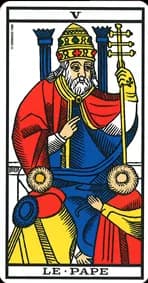
Arcane V
The Hierophant
Transmission, meaning, mediation, teaching, connection.
The Hierophant is an arcana of transmission and passage. He connects, teaches, blesses, clarifies and puts one in touch with a dimension of meaning, value or tradition. He does not speak only of authority, but of authority grounded in mediation and right speech.
Read the full card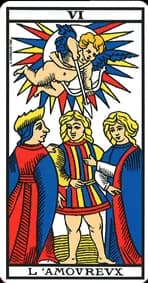
Arcane VI
The Lovers
Choice, bond, desire, hesitation, commitment.
The Lovers is one of the great arcana of choice and relationship. It does not speak only of love, but also of tension between several directions, of desire, of the call of the heart and of the need to commit to a path.
Read the full card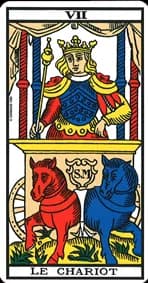
Arcane VII
The Chariot
Momentum, advance, conquest, direction, assertion.
The Chariot is the arcana of assumed movement. It indicates progress, taking direction, the will to conquer a space, to move forward or to leave hesitation behind and enter action.
Read the full card
Arcane VIII
Justice
Balance, truth, judgment, lucidity, uprightness.
Justice cuts through, measures, rebalances and demands clarity. It speaks of decision, correctness, responsibility, lucid examination and sometimes the need to restore order in a situation.
Read the full card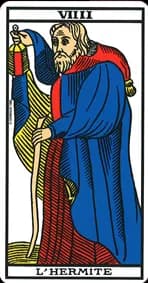
Arcane IX
The Hermit
Withdrawal, prudence, maturity, research, inwardness.
The Hermit advances slowly with his light. He symbolizes research, distance, prudence, deepening and wisdom acquired through experience. He invites one to slow down in order to understand more deeply.
Read the full card
Arcane X
Wheel of Fortune
Cycle, change, reversal, turning point, mutation.
Wheel of Fortune speaks of cycles in motion, reversals, changes of phase and realities that do not remain fixed. It reminds us that every situation is caught within a larger dynamic.
Read the full card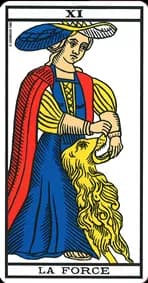
Arcane XI
Strength
Mastery, contained energy, courage, inner power.
Strength is not brutality but mastered power. It shows the capacity to contain, guide and inhabit one’s energy with courage, firmness and inner steadiness.
Read the full card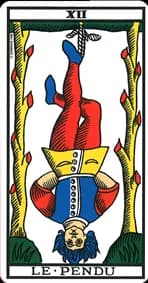
Arcane XII
The Hanged Man
Suspension, reversal of perspective, pause, waiting.
The Hanged Man suspends immediate action in order to open another point of view. He may speak of apparent blockage, but also of inner reversal, deep maturation and the time needed before right movement.
Read the full card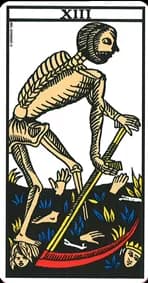
Arcane XIII
The Nameless Arcana
Radical transformation, cutting, ending, deep mutation.
Arcana XIII is one of the great cards of transformation. It cuts, clears, ends, frees and prepares another form. It should not be reduced to death in a literal sense: it speaks first of all of a powerful passage.
Read the full card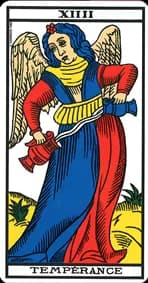
Arcane XIV
Temperance
Circulation, living balance, adjustment, appeasement.
Temperance circulates, adjusts, connects and soothes. It speaks of exchange, modulation, relative healing, fluidity and the art of proportion. It is an arcana of re-harmonization.
Read the full card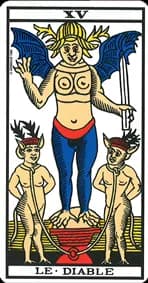
Arcane XV
The Devil
Desire, attachment, intensity, grip, dark power.
The Devil confronts us with raw energy: desire, fascination, dependency, instinctive power, shadow zones and the force of capture. It can be a source of lucidity as much as of entrapment.
Read the full card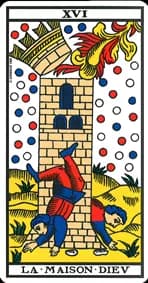
Arcane XVI
The Tower
Rupture, shock, collapse, truth, brutal liberation.
The Tower often indicates a discharge, a break, a revelation or an explosion. What seemed stable may crack, but that rupture can also free what was enclosed or artificially maintained.
Read the full card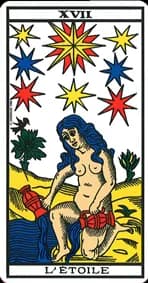
Arcane XVII
The Star
Simplicity, trust, inspiration, gentleness, naked truth.
The Star is an arcana of trust, stripping away, simple truth and calm connection to what is essential. It inspires without forcing and illuminates without dominating.
Read the full card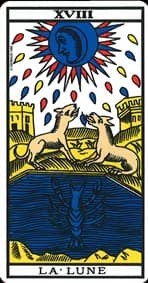
Arcane XVIII
The Moon
Imagination, unconscious, confusion, sensitivity, depth.
The Moon speaks of the nocturnal life of the psyche, of emotions, fears, deep resonances, intuition and unclear zones. It asks for nuance, listening and prudence.
Read the full card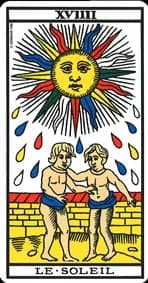
Arcane XIX
The Sun
Clarity, joy, vitality, obviousness, sharing, illumination.
The Sun illuminates, warms, gathers and makes visible. It speaks of vitality, clarity, agreement, manifest truth and sometimes success or restored harmony.
Read the full card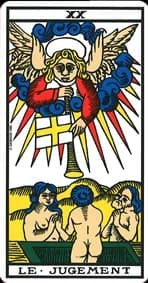
Arcane XX
Judgement
Awakening, call, rebirth, rising, passage.
Judgement is the arcana of awakening, calling and rising up. It announces an emergence, a return, a moment when something becomes possible, audible or alive again.
Read the full card
Arcane XXI
The World
Fulfillment, totality, integration, completion.
The World speaks of completion, achieved coherence, vast openness and integration. It often indicates a moment when the elements find a form of unity or overall accomplishment.
Read the full card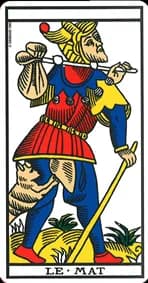
Arcane 0
The Fool
Freedom, wandering, the call of the road, out-of-frame momentum.
The Fool holds a singular place in tarot. He walks, crosses, exceeds frameworks, answers an inner call and carries the dynamic of a movement that does not easily allow itself to be fixed.
Read the full cardHow to seriously study the 22 major arcana
There are several ways to study the majors. The first, and simplest, is to work on them one by one. You observe the image, read the card page, note the main keywords, then try to reformulate the dynamic of the card in your own words. This method is excellent for building a solid foundation.
A second approach is to study them by families or by symbolic axes: cards of beginning, cards of authority, cards of crisis, cards of passage, cards of light, cards of return to oneself. This makes it possible to perceive finer resonances and distinctions.
You can also work with them in one-card spreads or three-card spreads, in order to see how they behave in actual practice. That is often where study becomes alive: the card stops being an abstract notion and becomes a language in situation.
Finally, it is very useful to keep a study journal. Writing down what a card evokes, in which contexts it appears, what it brings to light and how your understanding evolves over time allows you to build a much deeper relationship with tarot.
Key takeaways
- The 22 major arcana form the symbolic core of Tarot de Marseille.
- They describe major human dynamics rather than simple events.
- Each card has a stable structure, but its meaning is always contextual.
- Studying them one by one is the best way to build a serious foundation.
- The detailed pages for each arcana make it possible to go much further in interpretation.
Related articles
Frequently asked questions
What do the 22 major arcana of Tarot de Marseille mean?
The 22 major arcana represent the great symbolic structures of Tarot de Marseille: beginning, choice, transformation, crisis, fulfillment, withdrawal, light, desire and passage.
What is the difference between major arcana and minor arcana?
The major arcana carry the deck’s great symbolic dynamics, while the minor arcana bring more concrete, practical and contextual nuances.
Can the major arcana be learned one by one?
Yes. It is even an excellent method. Studying each card separately makes it possible to understand its own structure before learning how to read it in a full spread.
Do the major arcana have a fixed meaning?
No. Each arcana has a stable symbolic structure, but its interpretation always depends on the question, the position in the spread and the neighboring cards.
Which major arcana should you start with as a beginner?
Many people begin with The Magician, The Fool, The High Priestess, The Lovers or Justice, because these cards make it possible to quickly understand several major principles of tarot.
How to read the major arcana
Reading a major arcana does not mean assigning it a fixed meaning once and for all. A card retains a stable symbolic structure, but that structure is actualized differently depending on the question asked, the position it occupies in the spread, the possible presence of reversed cards and its relationships with the other cards.
For example, The Chariot may speak of victory, but also of movement that is too rushed; The Hermit may signify wisdom, but also excessive withdrawal; The Tower may represent a painful crisis, but also a necessary liberation. Meaning is never mechanical.
A serious reading of the major arcana therefore unfolds on several levels: image, symbol, number, place within the sequence, spread context and overall coherence. This is the approach Tarot Nova favors: a structured, symbolic, nuanced and demanding reading.