
Summary (clear reading)
Upright : The Emperor upright indicates a time to solidify: framework, structure, clear decisions, stable plan. Very favorable for formalizing: contract, pricing, rules, process, schedule. It is the card of 'this holds.' It asks for a line: one fully assumed choice, followed by consistency.
Reversed : The Emperor reversed indicates either too much rigidity or not enough structure. In one case: control, tension, poorly handled authority. In the other: fragile base, insufficient organization, avoided decisions. The solution: strengthen the foundations simply, clarify the rules, then adjust with flexibility.
Visuals & symbols (classic Marseille)
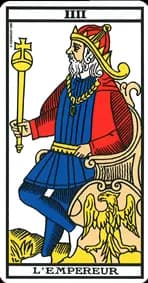
A seated sovereign, solid and composed, sometimes with one leg crossed and holding a scepter. Everything evokes mastery of territory: managing, protecting, stabilizing. The Emperor does not dream: he administers and makes reality hold together.
The Marseille setting is often simple: what matters is presence and groundedness. The atmosphere is earthy: one builds, takes responsibility, and makes clear decisions. Where the Empress clarifies, the Emperor executes and structures.
- Red (power) : Willpower, energy of construction, decision.
- Blue (mastery) : Management, lucidity, coherence, cool vision when needed.
- Yellow/Gold (legitimacy) : Authority, status, credibility, concrete radiance.
- Gray/earth (reality) : Foundations, matter, constraints: the real world.
- White (clarity) : Clear framework: simple rules, healthy boundaries.
- Red : To decide, act, build.
- Blue : Mastery, management, perspective.
- Yellow/Gold : Legitimacy, status, authority.
- Earth/Gray : Foundations, concreteness, durability.
- White : Clear rules, boundaries.
- The throne : Grounded seat: stability, posture, solid base.
- The scepter : Power to act and decide: firm direction.
- The armor / shield (depending on edition) : Protection: securing what matters.
- The motionless posture : Control: holding over time, not just starting.
Origins & psychological reading
In the Marseille tradition, the Emperor represents civil authority, the power that organizes the city. He embodies applied law, order, and management of territory: making things hold and endure.
Archetype of the builder and protector: he structures, plans, and secures. He turns energy into a system: routines, rules, decisions, responsibility.
The shadow is rigidity: controlling instead of building, imposing instead of framing. Or conversely, a facade of authority with fragile foundations (instability).
Upright meaning (strengths, risks, best uses)
The Emperor upright indicates a time to solidify: framework, structure, clear decisions, stable plan. Very favorable for formalizing: contract, pricing, rules, process, schedule. It is the card of 'this holds.' It asks for a line: one fully assumed choice, followed by consistency.
- stability
- decision
- calm leadership
- sense of responsibility
- ability to structure
- endurance
- too hard / too strict
- refusing to adjust when necessary
- confusing control with safety
- closing yourself to help or feedback
- structuring an offer (price, scope, rules)
- setting up a process (checklist, schedule)
- signing a contract / securing an agreement
- stabilizing a project (roadmap, priorities)
- setting clear boundaries
- building a lasting routine
Reversed meaning (nuance + rebalancing)
The Emperor reversed indicates either too much rigidity or not enough structure. In one case: control, tension, poorly handled authority. In the other: fragile base, insufficient organization, avoided decisions. The solution: strengthen the foundations simply, clarify the rules, then adjust with flexibility.
- framework too strict (it suffocates)
- blockage through fear of losing control
- disorganization: no system that holds
- authority / ego conflict
- false solidity: nice facade, weak base
- return to 3 simple rules (not 30)
- set a minimal schedule (2 blocks/day)
- clarify price/scope/boundaries in writing
- delegate or ask for a pragmatic opinion
- accept adjustments without tearing everything down
In situations (love, work, money...)
- Stable, reliable relationship, with a need for structure and safety.
- Setting healthy boundaries, building for the long term.
- Concrete commitment is possible.
- Rigidity, control, lack of flexibility.
- Authority conflict (who decides?).
- Unexpressed need for safety → tension.
- Excellent for structuring a business and formalizing an offer.
- Contracts, organization, management, process: things are being put in place.
- Very good for stabilizing income and scheduling.
- Too much control or too much chaos.
- Vague rules, scope creep.
- Power struggles at work.
- Financial stabilization through management and discipline.
- Good time for budget, margins, pricing, forecasting.
- Building a lasting base.
- Expenses linked to control (trying to secure everything too quickly).
- Rigidity preventing you from seizing an opportunity.
- Lack of structure → losses.
- Solid base: housing, paperwork, material organization.
- Very good for application files, guarantees, planning, logistics.
- A stable 'territory' is being built.
- Rigidity (standards too high) or insufficient preparation.
- Conflict with an authority figure (landlord, administration).
- Tension: need for safety poorly handled.
- Discipline and practice: progress through consistency.
- Grounding: embodied spirituality, not theoretical.
- Healthy structure for moving forward.
- Dogmatism, rigidity, judgment.
- No routine → no progress.
- Mental control instead of grounding.
Role in spreads (3 cards, cross, 12 houses)
Past : A foundation has been built (or you understood what structure was missing).
Present : You need to decide and formalize: framework, rules, organization.
Future : Stability if you hold the line; otherwise tension/rigidity to be corrected.
Advice : Write the rules of the game and apply them consistently.
Situation : Need for structure and security: making reality hold together.
Challenge : Rigidity or chaos: finding the right framework.
Resource : Decision, endurance, sense of management.
Outcome : Lasting stabilization if you formalize and stay consistent.
Advice : Simple process + clear limits + routine.
In the 12 houses, the Emperor shows where you must build a base: framework, boundaries, organization. Upright = solidity. Reversed = rigidity or unstable base.
Upright : You inspire reliability and calm leadership.
Reversed : Harsh or unstable image: control or hesitation.
Action : Define your line and hold it for 30 days.
Watch out : Do not confuse firmness with harshness.
Upright : Budget, pricing, margin: you can secure things.
Reversed : Losses through lack of system or excessive rigidity.
Action : Simple table: income/expenses/margin.
Watch out : Do not make decisions out of fear.
Upright : Clear communication: you create structure and things move forward.
Reversed : Tension: dry or vague messages.
Action : Write short, goal-oriented messages.
Watch out : Avoid power struggles.
Upright : Very good for a stable base, strong application file, logistics.
Reversed : Rigidity or lack of preparation.
Action : Housing checklist + plan B.
Watch out : Do not bet everything on one option.
Upright : Structure your project: roadmap and execution.
Reversed : Too strict (it kills creativity) or too vague.
Action : 1 measurable goal / week.
Watch out : Keep some room for play.
Upright : Discipline = results.
Reversed : Disorder or exhausting rigidity.
Action : 2 fixed blocks per day.
Watch out : The framework must be sustainable.
Upright : Good for securing a relationship in writing.
Reversed : Authority conflict, vague limits.
Action : Clear quote/contract/scope.
Watch out : Do not leave gray areas.
Upright : Clarify, protect, formalize.
Reversed : Power struggle, control.
Action : Write everything down, verify everything.
Watch out : Stay fair, not harsh.
Upright : You can structure your departure and secure it.
Reversed : Too much control or not enough preparation.
Action : 30-60-90 day plan.
Watch out : Do not block yourself through fear.
Upright : Credibility, stability, leadership.
Reversed : Rigidity or unstable positioning.
Action : Positioning + proof.
Watch out : The framework must serve the result.
Upright : Serious partnerships are possible.
Reversed : Ego conflicts, control.
Action : 2-3 key partners, not 20.
Watch out : Avoid power struggles.
Upright : You can ground yourself and hold a line.
Reversed : Control as protection: rigidity.
Action : Simple structure + breathing.
Watch out : Safety also comes from flexibility.
The Emperor becomes very fluid with Temperance/Strength (gentle discipline). He hardens with Devil/Tower if control takes over.
Correspondences (optional layer)
Element / astrology / Hebrew correspondences vary depending on the school. Here they are offered as an optional layer of study, not as the historical origin of the Marseille tradition.
Pairings & echoes (associated cards)
Timing & rhythm
Construction energy: more often weeks → months. It settles and lasts.
- setup within 2 to 6 weeks
- stabilization over 2 to 3 months if you hold the framework
- delay if you avoid making decisions
- acceleration as soon as you write the rules and stick to them
The Emperor does not 'save' by magic: he rewards consistency and structure.
Yes. — Yes if you establish a clear framework and commit for the long term.
Rather no / not stable. — Too rigid or not structured enough. Adjust the foundations.
Practice (exercises & prompts)
- Write down a maximum of 3 rules (price/scope/limits).
- Write down a maximum of 3 routines (daily/weekly).
- Apply them for 7 days.
- Adjust without breaking the system.
- List what needs to be secured (money, contract, schedule).
- Take 1 securing action per day.
- Block distractions for 7 days.
- Measure the gain (stress ↓, results ↑).
- What simple framework would give me 80% more stability?
- Where am I controlling instead of building?
- Which boundaries do I need to put in black and white?
- Which routine would make me sustainable over 3 months?
Symbolic and personal reading: does not replace professional advice (medical, legal, financial).