Learning tarot
The 10 most commonly used tarot spreads
Tarot is not simply about “drawing cards.” What gives shape, depth and coherence to a reading is the structure of the spread. Each method distributes the cards according to precise positions , and each position guides the interpretation.
Some spreads are short, educational and very useful for beginners. Others are broader, more analytical or more panoramic. Knowing them helps you choose the right form for the right question.
In this article, we will go through the ten most commonly used tarot spreads, explaining for each one its logic, its interest, its structure, its preferred uses and the points of caution needed to interpret it seriously.
1. The one-card spread
The one-card spread is one of the simplest forms of tarot reading, but also one of the most demanding. A single card is drawn to illuminate an axis, a climate, a dominant dynamic or an essential point of awareness.
Its apparent simplicity is misleading. When only one blade speaks, it cannot be “balanced” by any other. The whole interpretation therefore depends on the ability to read the symbolic structure of the arcana, connect that structure to the question and bring out a fair orientation without falling into oversimplification.
This spread is particularly useful in several cases: a card of the day, a punctual clarification, a teaching exercise, or a situation in which one simply wants to identify the main tone of a moment. It is very suitable for beginners, provided it is not treated as a simple keyword lottery.
Its advantage is its sobriety. It requires precision, distance and fine observation. Its drawback is that it offers few structural supports: if the question is vague or too broad, the single card may be interpreted too generally.
In practice, this spread works well with formulations such as: “What is the main dynamic of this situation?”, “What axis do I need to understand today?” or “What energy is currently moving through this project?”
2. The three-card spread
The three-card spread is probably one of the most commonly used in modern tarot learning and practice. It offers an excellent balance between simplicity and depth. With three cards, you are no longer reading a single axis: you are already entering a relationship, a tension, a progression.
Its structure can vary depending on the chosen method. The most classic form is “past / present / outcome,” but there are other equally relevant organizations: “situation / obstacle / advice,” “me / other / relationship,” or “cause / current state / likely direction.”
This spread has an immense educational virtue: it teaches you to read the cards together rather than in isolation. It invites you to observe contrasts, repetitions, changes in tone, continuities and lines of force. It is often in this relationship between the blades that the true intelligence of the spread appears.
For example, if a tense card is followed by a more open card, the whole may speak of a passage. If a card of initiative is framed by two cards of restraint, the reading becomes more nuanced: yes, something wants to begin, but not without maturation or conditions.
The three-card spread is particularly suitable for concrete, limited and well-formulated questions. It is excellent for understanding a small situation, a phase, an imminent decision or a simple relational dynamic. It becomes less comfortable as soon as the subject becomes very broad or involves many areas of life.
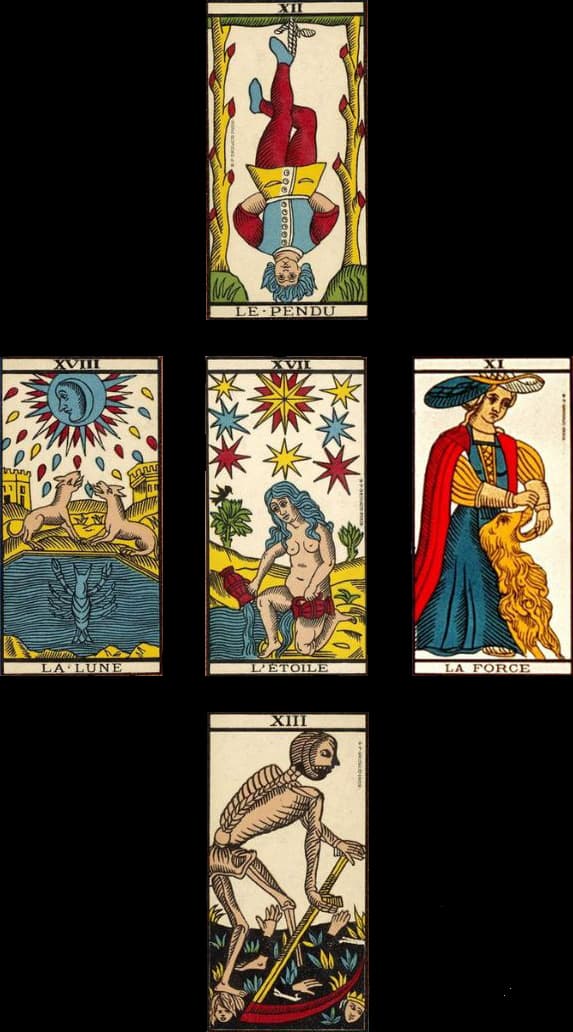
3. The cross spread
The cross spread is one of tarot’s great classic structures. It is very popular because it allows for an analytical reading of a complex situation without becoming as vast as a panoramic spread.
In its most frequent form, four cards occupy four distinct functions: what is at the heart of the situation, what slows or blocks, what helps or supports, and the probable evolution . Some methods then add one or more synthesis cards.
The strength of this spread lies in its structural clarity. It forces you not to confuse the registers. A card drawn in a blocking position is not read like a card drawn in a resource position. This framework avoids a large part of interpretive drift.
It is also a very interesting spread for periods of tension, choice, blockage or transition. It helps clarify what is really at stake, what resists, what helps and in what direction the situation seems to tend if nothing essential changes.
Where the cross spread becomes truly rich is when you begin to read not only each position, but also the links between them: how the help responds to the obstacle, how the initial situation prepares the evolution, and how one card can deeply requalify another.
4. The yes / no spread
The yes / no spread is often requested because it promises a quick answer. Yet, in a serious approach to tarot, it should be used cautiously. Tarot speaks better about dynamics, tensions, conditions and orientations than about purely binary answers.
This does not mean that this type of spread should be banned. It can be useful when someone wants a simple indication, provided they understand that the “yes” or “no” is never purely mechanical. Often, the spread answers rather: yes, but; no, for now; possible under certain conditions; or no, as long as a certain blockage remains.
Several practitioners use one, three or five cards to nuance the answer. A very open card can support an affirmative orientation; a card of blockage, halt or contradiction can lean toward no; a mixed group often brings a more nuanced reading.
The true interest of this spread is therefore not to decide brutally, but to help understand the feasibility or tendency of a situation. Used intelligently, it becomes a quick orientation tool rather than an absolute verdict.
This is a spread to reserve for very precise questions. The vaguer the question, the more artificial and poor the binary answer becomes. A good use of yes / no therefore requires excellent wording beforehand.
5. The relationship spread
The relationship spread is used when one wants to understand a dynamic between two people: a love relationship, a family bond, a partnership, a professional tension or a developing connection.
Its structure varies a lot, but a common form consists of drawing one card for oneself, one card for the other person, one card for the relationship itself, and possibly one or two additional cards for the blockage and the orientation. The interest of this spread is that it reveals not only the two poles of the relationship, but also the “third term”: the relational space itself.
In serious reading, two pitfalls must be avoided. The first is projection: too quickly attributing to the other what one feels oneself. The second is psychological oversimplification: believing that a card definitively describes a person. In this kind of spread, the cards often describe relational positions, link dynamics, tensions or modes of commitment more than fixed essences.
This spread is valuable for identifying asymmetries: one moves forward, the other hesitates; one seeks clarity, the other remains in ambivalence; the relationship itself contains richness, but also a structural contradiction. It therefore allows one to go beyond the simple question “is this person thinking about me?” and enter into a more mature reading of the bond.
It is particularly suitable when the relationship is already established or when there is a real tension. It is less reliable when it serves to feed obsession or completely replace dialogue with reality.
6. The decision spread
The decision spread is designed for moments when several options open up and the subject hesitates between different paths. It does not merely say which option is “good”; it helps illuminate the logic, cost, scope and potential of each choice.
It can take several forms. One of the most common consists of comparing two paths: one card or a small group of cards for option A, another for option B, then a card of advice or global orientation. Other methods provide one card for motivation, one for fear, one for the real stake and one for the most coherent path.
This spread is particularly interesting because it forces you to distinguish desire, feasibility, coherence and the maturity of the moment. One option may be attractive but premature. Another may seem less brilliant but more just. A third may be impossible as long as a certain blockage has not been worked through.
The most common mistake is to seek magical validation in this spread. In reality, a good decision spread does not remove responsibility for choice; it refines discernment. It shows what each path involves, what it demands and what it tends to produce.
For this type of reading, it is essential that the question be very well formulated. The clearer the alternative, the more finely and relevantly tarot can respond.
7. The path spread
The path spread emphasizes movement. It does not merely photograph a situation: it seeks to show a journey, a progression, a passage from one state to another. It is a very interesting structure when one wants to understand how a situation may evolve over time.
Depending on the method, the cards may represent the starting point, the current stage, the obstacle, the resource, the necessary passage and the final direction. Sometimes they are literally laid out as a path, which reinforces the visual and dynamic dimension of the spread.
This type of structure works well for questions of transformation, projects, rebuilding, professional repositioning or inner maturation. It is less suited to immediate answers than to understanding a process.
Its major interest is that it reminds us that a situation is not reduced to its current state. Between the starting point and the outcome, there are stages, slowdowns, thresholds and sometimes unavoidable passages. This logic of the path is very compatible with reading tarot as a reading of dynamic rather than as a fixed verdict.
The path spread nevertheless requires a global reading. Each card should not be treated as an independent answer. One must read the sequence, the rhythm, the shifts in tone and the turning points.
8. The astrological spread
The astrological spread is inspired by the logic of life areas found in astrological tradition. It distributes the cards in a structure that seeks to embrace several sectors of experience: identity, resources, communication, home, creation, daily life, relationship, transformation, vision, vocation, projects and psychological background.
This type of spread is particularly rich for people who enjoy panoramic and structured readings. It offers an overview of a period, a year, a turning point or an overall question.
The issue is not only to define each area separately. The real work is to identify the correspondences between sectors, the tensions, the reinforcements, the empty zones and the dominant houses. In other words, it is an architectural reading, not a simple succession of mini-answers.
This spread requires a certain level of mastery because it produces a lot of information. It is ideal for an in-depth reading, but excessive for a very punctual question. It should therefore be reserved for moments when one is seeking a broad vision.
Used with method, it becomes one of the most powerful tools for mapping a period and bringing out the major symbolic axes of a cycle.
9. The 12-house spread
The 12-house spread is undoubtedly one of the richest and most ambitious forms of panoramic reading. Each card is placed in a house corresponding to a specific area of existence.
This structure is particularly suitable when one wants to understand a year, a phase of life, a major cycle or an overall repositioning. One is no longer simply asking about a local difficulty; one is seeking to map an entire period.
This spread is extremely interesting because it forces one to think about the areas in relation to each other. The House I is not read independently from the House VII. The House II often dialogues with the House VIII. One then enters into a reading of symbolic axes.
Its main strength is its depth. Its main risk is dispersion: if each house is read in isolation, the overall logic is lost. This spread therefore requires a true global reading, with intermediate and final syntheses.
In a premium and serious approach, this is one of the most beautiful spreads possible, provided one has the time, the method and the interpretive maturity required.
10. The synthesis spread
The synthesis spread, or more precisely the use of a synthesis in a spread, aims to bring out the dominant axis of the reading. It does not replace the main cards; it condenses them. It allows the overall coherence to be shaped.
Depending on the method, this synthesis can be obtained in different ways: an additional card, a final card, numerical reduction, or a concluding reading drawn from the previous cards. In all cases, its role is to bring out the central tone of the spread.
It is particularly useful when the reading contains several cards, several tensions or several levels of meaning. The synthesis helps avoid dispersion. It answers a simple question: at bottom, what is the core of this spread?
However, synthesis must be handled carefully. Used badly, it can flatten the richness of the spread under an overly quick conclusion. Used well, it acts as an intelligent condensation, a form of higher readability.
In serious practice, synthesis serves less to “look nice” than to reinforce coherence. It is particularly valuable in complex readings, enriched cross spreads and panoramic structures.
How to choose the right spread?
There is no absolutely best spread. The right spread is the one that matches the nature of the question, the level of detail sought and the depth of reading desired.
For a simple axis or a learning exercise, one card may be enough. For a short but structured situation, three cards are often ideal. For a more complex issue, the cross offers a robust analytical framework. For a panoramic reading, the astrological spread or the 12 houses make it possible to embrace a broader cycle.
In reality, mastering tarot does not only mean knowing the cards, but also knowing which structure to choose, why to choose it and how to read it coherently.
Key points
- A tarot spread is a reading structure, not just a layout of cards.
- The one-card spread is excellent for beginners, but it requires real interpretive precision.
- The three-card spread and the cross are among the most educational and widely used methods.
- Relationship, decision and path spreads are useful for targeted issues.
- Astrological structures and the 12 houses allow much broader panoramic readings.
- A good reading always depends on the quality of the question, the coherence of the positions and the ability to synthesize.
Related articles
Frequently asked questions
What is the simplest tarot spread for beginners?
The one-card spread is generally the simplest way to begin. It forces you to focus on a single arcana, on its symbolic structure and on the question asked, without multiplying variables.
What is the most commonly used tarot spread?
The three-card spread and the cross spread are among the most widely used methods. The first is very educational, while the second allows for a more structured analysis of a situation.
How many cards should you draw for a good spread?
There is no absolute ideal number. The right spread is the one that matches the question. One card may be enough for a clear axis, while a complex issue may require a broader structure such as the cross or the 12 houses.
Can you invent your own tarot spread?
Yes. Many practitioners create their own structures. What matters is defining coherent, understandable positions that are truly useful for interpretation.
Do all spreads work with the Tarot de Marseille?
Yes, provided the method is adapted to the deck being used. The Tarot de Marseille lends itself very well to structured spreads, especially when one favors a symbolic, contextual and coherent reading.