
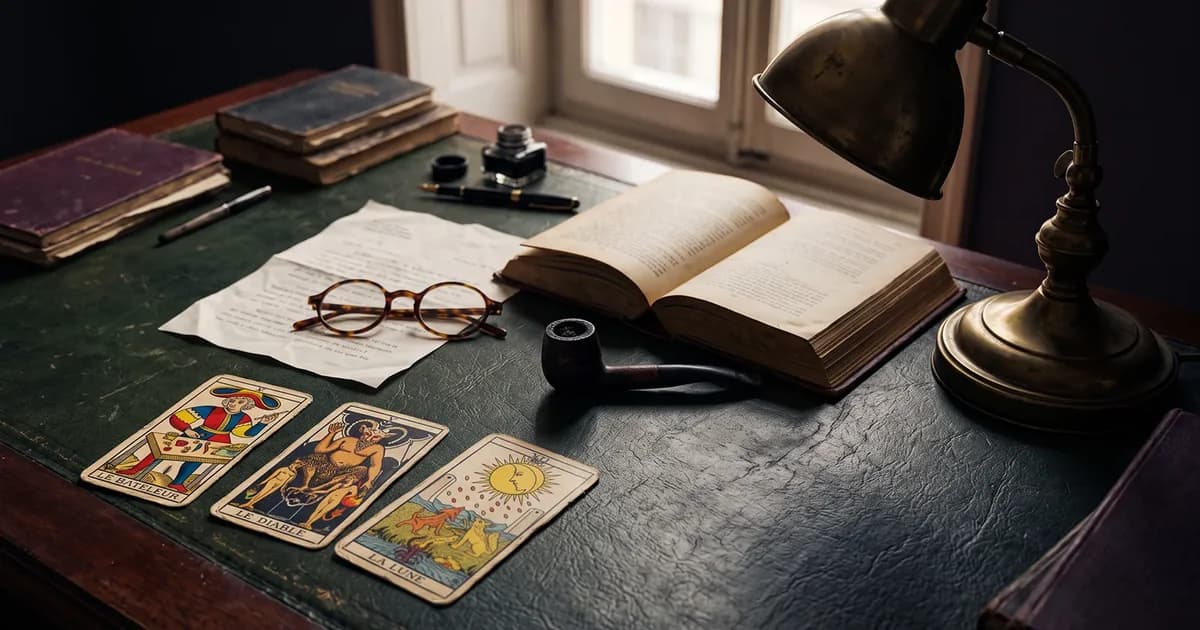
Tarot and psychology
Jung and tarot: what Carl Jung actually said, and what others claim he said
Carl Gustav Jung spoke about tarot a handful of times in thirty years: a letter in 1930, a seminar in 1933, one paragraph of the Collected Works (9/I, § 81), a research program abandoned around 1954, a letter in 1960. Never a book, never a chapter. He designed no deck, and nothing suggests he ever read the cards for a patient.
What he said fits in a few careful, precise sentences: “psychological images” distantly related to the archetypes of transformation, and an “intuitive method” comparable to the I Ching. This article gathers those sentences in his own words, places them in context, then sifts through what “Jungian” books, courses, and decks have had him say ever since.
Published on October 8, 2026 · updated on October 8, 2026 · Stéphane Gamot
Key points
- Jung never wrote a book or a chapter on tarot. Jung and Tarot (1980) is by Sallie Nichols, published nineteen years after his death.
- His one published and revised sentence (Collected Works 9/I, § 81) says the tarot pictures seem “distantly descended from the archetypes of transformation.” Two hedges in a single sentence.
- In 1933, he described the cards as “symbols with which one plays” and the spread as an intuitive method for reading “the conditions of the present moment.”
- Between 1950 and 1954, a group at the Jung Institute studied tarot on his behalf, with Grimaud’s Ancien Tarot de Marseille. His own verdict: too few co-workers, too little means, so they stopped.
- The “Fool’s journey” as individuation, the “Jungian tarot,” the quotes about the “mirror of the soul”: all of it comes after Jung, or was made up.
How many times did Jung talk about tarot?
Seven times, as far as we know, and never at length: two letters (1930, 1960), two seminars (1933, 1936–1940), one published paragraph (Collected Works 9/I, § 81), a footnote in the synchronicity essay (1952), and a research program at the Jung Institute (1950–1954), known through witnesses. The table below sorts them by date and by weight.
This count rests on the Collected Works, the two volumes of Letters (Princeton, 1973 and 1975), the seminars edited by Princeton, and the survey compiled in 2008 by tarot historian Mary K. Greer, who was able to consult the handwritten notes of the 1950 group. A passing remark in an unpublished seminar may be missing; no important text is.
The seven traces, by date
| Date | Source | What he says | Weight |
|---|---|---|---|
| Sept. 16, 1930 | Letter to Mrs. Eckstein (Letters, vol. 1, p. 77) | He “knows of” the tarot, credits it to the “Spanish gypsies,” “the oldest cards historically known” | Weak: a letter, and a historical error |
| Mar. 1, 1933 | Visions seminar (ed. Claire Douglas, Princeton, 1997, vol. 2, p. 923) | A spoken digression: “symbols with which one plays,” an “intuitive method” analogous to the I Ching, the hermaphroditic Devil | Medium: notes taken by the audience, not reviewed by Jung |
| 1934, revised 1954 | “Archetypes of the Collective Unconscious,” Collected Works 9/I, § 81 (trans. R. F. C. Hull) | One sentence: the set of tarot pictures seems “distantly descended from the archetypes of transformation” | Strong: written, published, and revised by Jung |
| 1936–1940 | Children’s Dreams seminar (Princeton ed., 2008, p. 351) | A remark on blue, “the color of the moon, of silver, and of the soul” in alchemy and tarot | Weak: seminar notes, incidental mention |
| 1950–1954 | Study group at the C. G. Jung Institute, reported by Deirdre Bair (2003, p. 549) and by Hanni Binder’s notes | Jung has tarot studied so he can learn to read it; the group settles on Grimaud’s Marseille, then disbands | Medium: third-party accounts and notes |
| 1952 | Synchronicity, Collected Works 8 (separate Princeton edition, p. 107, note 2) | A footnote reports that researchers at the Institute are studying “intuitive methods”: I Ching, geomancy, tarot, numerology, astrology | Strong, but thin: a single footnote |
| Feb. 9, 1960 | Letter to A. D. Cornell (Letters, vol. 2, p. 538) | His verdict on the Institute experiment: “too few co-workers and too little means,” so they had to stop | Strong: Jung speaks in the first person, sixteen months before his death |
Two absences weigh as much as these presences. Tarot appears neither in Psychology and Alchemy (1944) nor in Mysterium Coniunctionis (1955–1956), the two major books in which Jung studies series of symbolic images. In the twenty volumes of the Collected Works, we found one sentence and one footnote.
This silence is not a judgment: Jung devoted hundreds of pages to the I Ching, astrology, and alchemy, and he found tarot interesting enough to have it studied. But that is the proportion to keep in mind before reading “according to Jung” on the back of a deck’s box.
1930: “Yes, I know of the Tarot” (and a historical error)
On September 16, 1930, Jung replies to a correspondent, Mrs. Eckstein, who has asked him about tarot. He says he knows of it and describes it as “the pack of cards originally used by the Spanish gypsies, the oldest cards historically known.” Two claims, two errors: this is nineteenth-century legend, not history.
Playing cards are documented in Europe from the 1370s; tarot was born at the courts of northern Italy around 1440; the Romani people had nothing to do with its birth. Jung repeats, without checking it, a genealogy forged by the French occultists, from Court de Gébelin (1781) to Papus (1889), for whom tarot came from Egypt and had traveled with the “Bohemians.”
Above all, the letter tells us one thing: in 1930, Jung knows tarot through occultist books, not through historians or through practice. That is useful for reading what follows. Every time he speaks of the cards, it will be with that vocabulary, and from that bookshelf.
1933: “symbols with which one plays”
On March 1, 1933, during his seminar on the visions of Christiana Morgan, Jung pauses on tarot because he is looking for a hermaphroditic figure in it. What he then says, in English, to his audience is the fullest description of the cards he ever gave. One page, no more.
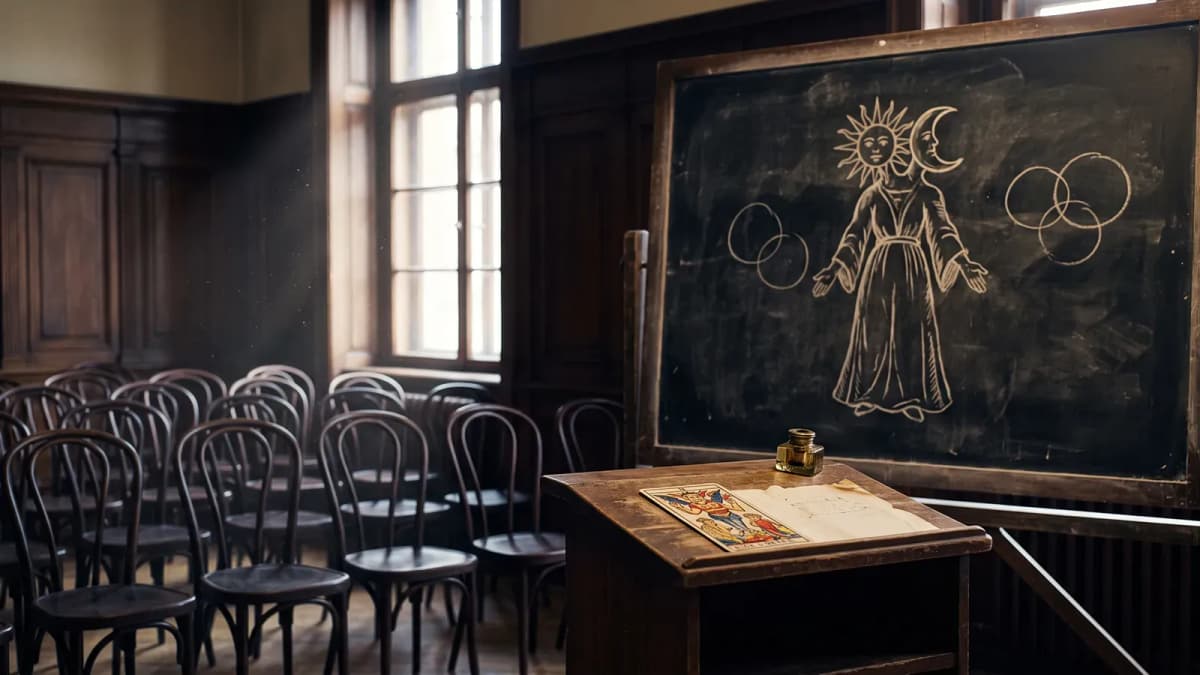
“They are psychological images, symbols with which one plays, as the unconscious seems to play with its contents,” he says (the seminar was given in English; all quotations here follow the Princeton and Bollingen editions). The twenty-one picture cards carry, in his view, “sort of archetypal ideas, of a differentiated nature,” mixed in with the ordinary constituents of the flow of the unconscious.
Hence the use he grants them: tarot “is applicable for an intuitive method that has the purpose of understanding the flow of life, possibly even predicting future events, at all events lending itself to the reading of the conditions of the present moment.” And he adds the analogy that stuck: “It is in that way analogous to the I Ching.”
Read the sentence in full. Jung does not rule out prediction, but he demotes it to a hypothesis (“possibly”) and keeps the essential: a reading of the present state. He explains that reading by a correspondence between the situation of the moment and the state of the collective unconscious, nineteen years before giving that idea the name synchronicity.
Then he returns to what he was looking for: in the tarot there is a hermaphroditic figure, called the Devil. For him, the androgyny of the Devil stands for the union of opposites, which in alchemy would be the gold, and he notes that such a union looks diabolical to the Christian mind. On a Tarot de Marseille, The Devil does indeed have breasts and male attributes: Jung is describing a card he has in front of him.
Two details remind us that he is no tarot historian. He states that these cards are the origin of our ordinary playing cards, when it is the other way around, and he counts twenty-one trumps instead of twenty-two, The Fool being unnumbered. The interest of the page lies elsewhere. It lies in the verb to play.
Why “play” is the important word
Jung does not say the cards contain knowledge, nor that they reveal the future. He says one plays with them, as the unconscious plays with its contents: combinations, juxtapositions, figures that answer one another. It is a definition of the reading as an exercise of imagination, not as an oracle.
1934–1954: the only published sentence (Collected Works 9/I, § 81)
The only sentence on tarot that Jung wrote, published, and revised is in “Archetypes of the Collective Unconscious,” an Eranos lecture of 1934 revised in 1954: “It also seems as if the set of pictures in the Tarot cards were distantly descended from the archetypes of transformation.” It is paragraph 81 of the standard edition.
Context matters. Jung has just written that, to get an idea of the symbolic process, the picture series of alchemy are good examples. Tarot comes in as a comparison: another series of pictures, another process made of images, which in his view shows the same structure as the text of the I Ching, a rhythm of enantiodromia in which each state turns into its opposite.
Count the hedges: “it seems,” “distantly,” and an outside endorsement, “a very enlightening lecture by Professor Bernoulli.” Rudolf Bernoulli, a Zurich professor and Eranos speaker, is the man Jung credits with the idea rather than claiming it as his own. We are a long way from “for Jung, the 22 arcana are the archetypes.”
The nuance is not fussiness. For Jung, an archetype is an empty form, an inherited disposition to produce certain images; the images themselves, drawn, dated, colored, are archetypal images, always particular. A Tarot de Marseille card is not an archetype; at best, it is a distant descendant of one. That is exactly what the sentence says.
In English, the passage is in The Archetypes and the Collective Unconscious (Collected Works, vol. 9/I, trans. R. F. C. Hull, Princeton/Bollingen), at the same paragraph: the paragraph numbering of the Collected Works is identical in every language, which makes checking it a thirty-second job.
1950–1954: Jung has tarot studied for him, with a Marseille deck
In 1950, Jung entrusts four members of the Zurich Psychological Club with the study of one “intuitive method” each. Hanni Binder gets tarot, with the task of teaching him to read the cards. The group settles on a single deck, Grimaud’s Ancien Tarot de Marseille, and disbands around 1954 without a published result.
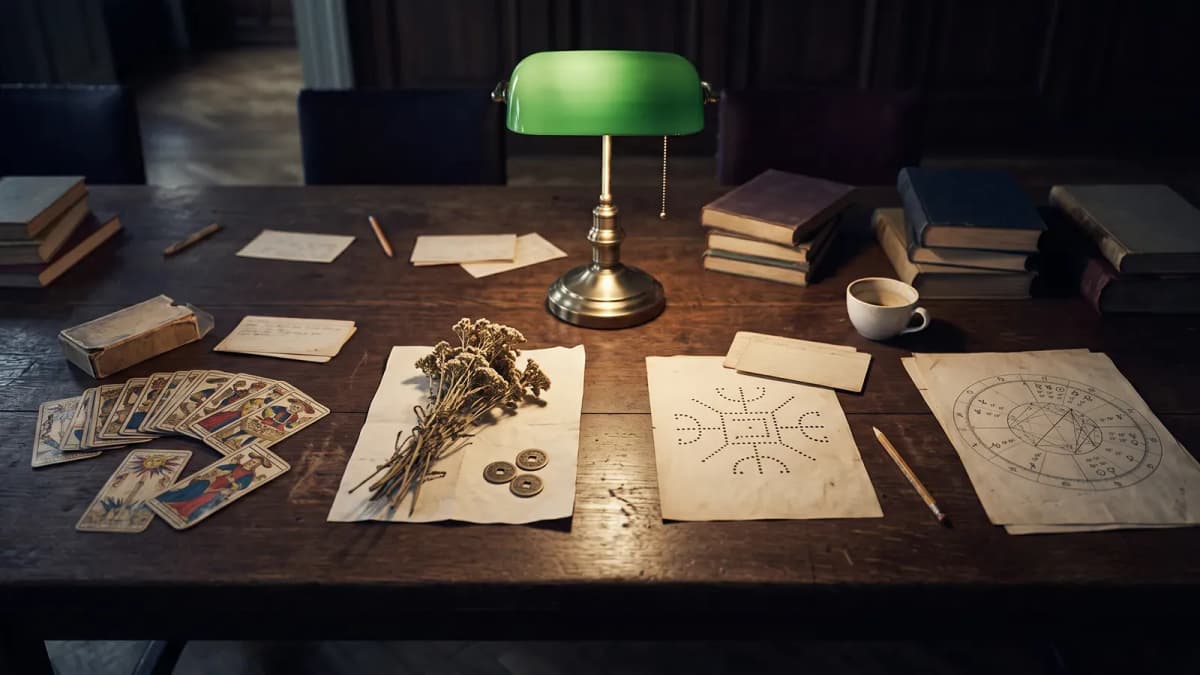
The episode is known from Deirdre Bair’s biography (Jung: A Biography, 2003, p. 549) and from Hanni Binder’s notes, kept at the Jung Institute in New York and consulted by Mary K. Greer. The choice of deck is the most interesting detail: according to Bair, the Marseille published by Grimaud, Paul Marteau’s 1930 version, was the only deck that had the properties and met the requirements of the metaphor Jung found in the alchemical texts.
Binder’s notes contain descriptions of the cards attributed to Jung: The Magician holds a golden ball in his right hand and a wand in his left; Wands stand for libido, Swords for spiritual power, Coins for matter, Cups for feeling.
But Greer points out that they repeat, almost word for word, Papus’s Tarot of the Bohemians (1889). In other words, when you read “Jung said that The Magician…,” you are most often reading Papus, relayed by Jung or by Binder.
Jung left two written traces of this program. A footnote in Synchronicity (1952) mentions a group of researchers at the C. G. Jung Institute who have for some time been studying the “intuitive methods”: I Ching, geomancy, tarot, numerology, astrology. And on February 9, 1960, he draws up the balance sheet for A. D. Cornell:
« As a matter of fact we had begun such experiments at the C. G. Jung Institute in Zurich, using the historically known intuitive, i.e., synchronistic methods (astrology, geomancy, Tarot cards, and the I Ching). But we had too few co-workers and too little means, so we could not go on and had to stop. »
Note the two words he chooses: “intuitive” methods, then “synchronistic.” Jung himself files tarot among the procedures he links to synchronicity, on the same footing as astrology and the I Ching. He took it seriously enough to put it in a research program, not enough to practice it, and he never published a line on what the group had found.
What the episode does not say
It does not say that Jung read tarot: it says he wanted to be taught, and that the lessons never came to anything. Nor does it say that Jung “endorsed” the Tarot de Marseille: the choice of deck was the group’s, for reasons of iconographic consistency, and Jung commented on it nowhere.
What Jung supposedly said about tarot: seven claims, fact-checked
The claims below keep coming back in books, courses, and deck descriptions, often with Jung’s name as a guarantee. For each one: what you read, and what the sources are worth.
| You often read | Verdict | What the sources say |
|---|---|---|
| “Jung wrote a book on tarot” | False | None. Jung and Tarot: An Archetypal Journey (1980) is by Sallie Nichols, an American author in the Jungian tradition, who reads the Tarot de Marseille in it. Jung died in 1961. |
| “Jung read the cards for his patients” | Nothing supports it | No mention in his writings, his letters, his seminars, or his biographies. The only documented practice is the 1950–1954 group, where he wanted to learn, and gave up. |
| “For Jung, the 22 arcana are the archetypes” | Distorted | He writes that they seem “distantly descended from the archetypes of transformation” (9/I, § 81); in 1933, “sort of archetypal ideas, of a differentiated nature.” An image is not an archetype. |
| “The Fool’s journey is individuation according to Jung” | Later | The phrase Fool’s Journey is Eden Gray’s (A Complete Guide to the Tarot, 1970); reading the 22 cards as a path of individuation is Nichols’s (1980). Jung never put the trumps in sequence. |
| “Synchronicity is the Jungian explanation of tarot” | Half true | Jung does file tarot among the “synchronistic methods” (1960 letter) and speaks as early as 1933 of a correspondence between the present state and the collective unconscious. But the 1952 essay deals only with the I Ching and astrology; tarot gets a footnote. |
| “There is a Jungian tarot designed or approved by Jung” | False | The so-called “Jungian” decks (Robert Wang’s in the late 1980s, others since) came out several decades after his death. Jung neither drew, commissioned, nor approved any deck. |
| “Jung said: tarot is a mirror of the unconscious” (and variants) | Unsourced | None of these phrases appears in the seven traces listed. A Jung quote on tarot with no volume and no date is almost always a summary of Nichols, or of a blog, turned into a “quote.” |
What these seven claims have in common: they extend Jung in a direction he did not take. That is not forbidden. Nichols offers a Jungian reading of the Marseille, and says so. The problem begins when the Jungian reading becomes “what Jung said.”
How to verify a Jung tarot quote in three questions
A Jung quote on tarot is checked with three questions: where (volume and paragraph, or date and recipient), when (before or after his death, in June 1961), and with what status (published text, letter, seminar notes, testimony). If any of the three goes unanswered, the quote is not one.
The Collected Works are numbered by paragraph, identically in every language: “9/I, § 81” can be checked in the English, German, or French edition. A letter is cited by date and recipient. A seminar, by session date and page of the Princeton edition. Everything else, “Jung used to say,” “according to Jung,” belongs to testimony or paraphrase, and must be presented as such.
The scale of sources
| Grade | Status | Example for tarot |
|---|---|---|
| 1 | Text written, published, and revised by Jung | Collected Works 9/I, § 81 (1934/1954); the footnote in Synchronicity (1952) |
| 2 | Signed letter | To Mrs. Eckstein, September 16, 1930; to A. D. Cornell, February 9, 1960 |
| 3 | Seminar notes, taken by the audience, edited afterward | Visions, March 1, 1933; Children’s Dreams, 1936–1940 |
| 4 | Third-party testimony or notes | Hanni Binder’s notes; Deirdre Bair (2003); Marie-Louise von Franz |
| 5 | Jungian reading by another author | Sallie Nichols (1980), Irene Gad (1994), Art Rosengarten (2000) |
| 6 | Quote with no source | “Tarot is a mirror of the soul” and its relatives |
This ranking does not say that grades 4 and 5 are worthless. It says in what capacity they are cited. “Jung thought that” requires grade 1 or 2; “a Jungian author proposes that” is enough for grade 5. Confusing the two is the source of almost everything in circulation.
Where does the Tarot de Marseille fit in?
Three Marseille cards run through Jung’s texts: The Magician and his golden ball in the 1950 notes, the hermaphroditic Devil of the 1933 seminar, The Moon and its blue, “the color of the soul,” from the Children’s Dreams seminar. And one specific deck, Grimaud’s Ancien Tarot de Marseille, chosen by his research group.
This is no catalog accident. In the Zurich of the 1930s to 1950s, the Marseille is the historical deck available, as opposed to the English Rider-Waite (1909), conceived by an occultist and drawn to serve a program. For a reader of alchemical texts, looking for old, uncommented images, the Marseille is the obvious choice.
Yet we must resist the opposite temptation: making Jung a patron of the Tarot de Marseille. He commented on no card in writing, and the descriptions Binder’s notes attribute to him come from Papus. What his choice does express is a preference of method, starting from the least interpreted images possible, which this site shares.
Reading tarot “the Jungian way,” without making him say what he never said
If you want to be faithful to Jung, tarot serves to read “the conditions of the present moment,” with images one plays with. Not to predict, not to diagnose, not to replace work with a professional. It is a demanding modesty, and it is all he said.
In practice, that means choosing open questions, looking at the cards as propositions rather than verdicts, and accepting that a reading says more about you than about the future. The three guides below spell out this way of working.
- What question to ask the tarot to get an answer you can use
- How to interpret a tarot card without reciting a meaning
- Reading the cards for yourself: the method, step by step
One clarification Jung would have signed: tarot is not psychotherapy, and none of his texts presents it as a clinical tool. If a question genuinely weighs on you, a mental health professional is the person to talk to; the cards can accompany a reflection, not replace it.
Where to go now
You now know what Jung said about tarot: little, carefully, and always in passing. You also know how to recognize what comes from elsewhere, and it is often interesting, provided it is signed with the right name.
The best way to honor his 1933 sentence is to apply it: take three cards, play with them, and read what they say about the present moment.
About the author
Stéphane Gamot — Founder of TarotNova, web application engineer. A Tarot de Marseille enthusiast since childhood, he treats it as a tool for asking questions, never as a tool for prediction, and builds the site's tools himself.
Published on October 8, 2026 · updated on October 8, 2026
Share this article
Sources
All Jung quotations follow the editions below (Hull’s translation of the Collected Works; Princeton for letters and seminars). Collected Works references are given by paragraph, identical in every language.
- C. G. Jung, “Archetypes of the Collective Unconscious” (1934, revised 1954), Collected Works, vol. 9/I, § 81, in The Archetypes and the Collective Unconscious, trans. R. F. C. Hull, Princeton University Press (Bollingen Series XX).
- C. G. Jung, Visions: Notes of the Seminar Given in 1930–1934, ed. Claire Douglas, Princeton University Press, 1997, vol. 2, p. 923 (session of March 1, 1933).
- C. G. Jung, Letters, ed. Gerhard Adler and Aniela Jaffé, Princeton University Press: vol. 1 (1906–1950), 1973, p. 77, letter to Mrs. Eckstein of September 16, 1930; vol. 2 (1951–1961), 1975, p. 538, letter to A. D. Cornell of February 9, 1960.
- C. G. Jung, Synchronicity: An Acausal Connecting Principle (1952), Collected Works, vol. 8 (The Structure and Dynamics of the Psyche); separate edition, Princeton University Press, p. 107, note 2.
- C. G. Jung, Children’s Dreams: Notes from the Seminar Given in 1936–1940, Princeton University Press, 2008, p. 351.
- Deirdre Bair, Jung: A Biography, Little, Brown, 2003, p. 549 (the 1950 group and the choice of the Grimaud deck).
- Mary K. Greer, “Carl Jung and Tarot,” marykgreer.com, March 31, 2008: survey of the sources and account of Hanni Binder’s notes.
- Sallie Nichols, Jung and Tarot: An Archetypal Journey, Samuel Weiser, 1980; reissued as Tarot and the Archetypal Journey, Weiser, 2019.
- Eden Gray, A Complete Guide to the Tarot, Crown, 1970 (epilogue “The Fool’s Journey”).
- Papus, Le Tarot des Bohémiens (The Tarot of the Bohemians), Paris, 1889 (the source of the card descriptions noted by Hanni Binder).
Frequently asked questions
Did Jung write a book on tarot?
No. No book, no chapter, no article. In the twenty volumes of the Collected Works, tarot takes up, as far as we know, one sentence (9/I, § 81) and one footnote (Synchronicity, 1952). The book Jung and Tarot is by Sallie Nichols, an American author in the Jungian tradition, and it came out in 1980, nineteen years after Jung’s death.
What exactly does Jung say about tarot in the Collected Works?
One sentence, at paragraph 81 of “Archetypes of the Collective Unconscious”: the tarot pictures seem “distantly descended from the archetypes of transformation,” an idea he credits to a lecture by Rudolf Bernoulli. The passage compares tarot to the alchemical picture series and to the I Ching, as examples of the symbolic process.
Did Jung use tarot with his patients?
Nothing suggests it. Neither his writings, nor his letters, nor his seminars, nor his biographers mention a reading done for a patient. The only documented practice is the 1950–1954 research group, in which Hanni Binder was to teach him to read the cards; the project stopped, according to Jung, for lack of co-workers and means.
Did the “Fool’s journey” idea come from Jung?
No. The phrase Fool’s Journey comes from Eden Gray (1970), and the reading of the 22 arcana as a path of individuation comes from Sallie Nichols (1980). Jung never put the trumps in sequence or linked The Fool to individuation. It is a Jungian reading, legitimate when signed with its real name, not a thesis of Jung’s.
Which tarot deck did Jung use?
In 1950, the Jung Institute group settled on Grimaud’s Ancien Tarot de Marseille (Paul Marteau’s 1930 version), judged the only deck consistent with the alchemical images Jung was studying. Jung himself commented on no card in writing; the descriptions noted by Hanni Binder borrow heavily from Papus’s Tarot of the Bohemians.
Is tarot a “synchronistic method” according to Jung?
Yes, that is his word. In a letter of February 9, 1960, he files tarot, with astrology, geomancy, and the I Ching, among “the historically known intuitive, i.e., synchronistic methods.” But his essay Synchronicity (1952) develops only astrology and the I Ching; tarot fits in a footnote.
Related articles
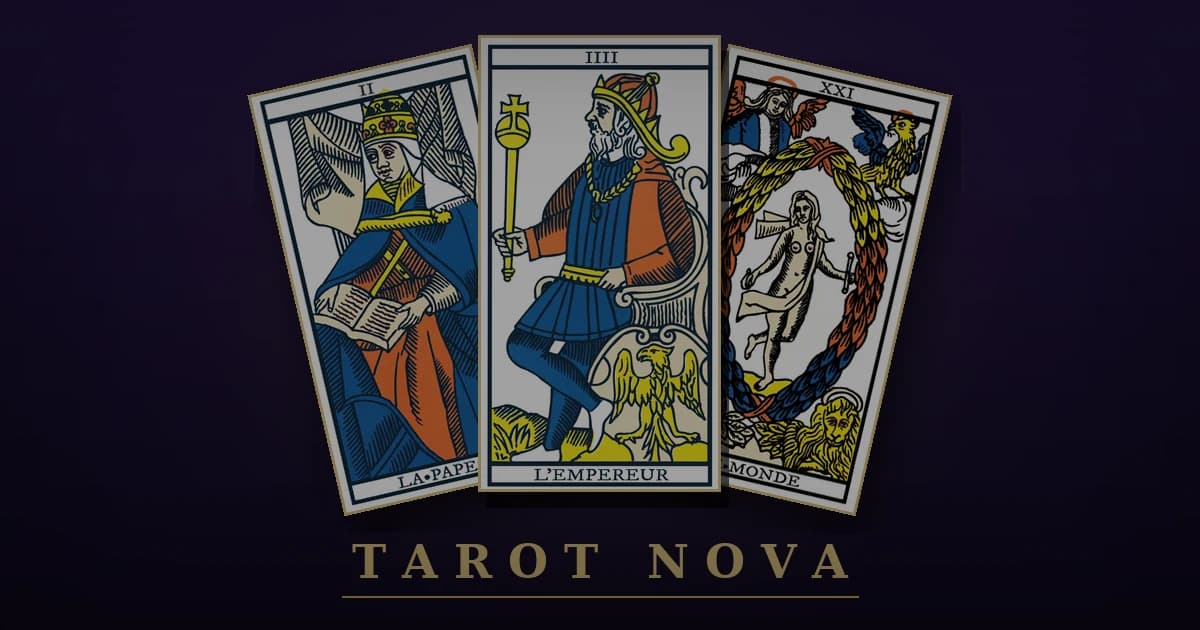
The history of Tarot de Marseille
From Italian origins to the Marseille tradition: an in-depth article to understand tarot as a historical, cultural and symbolic object.
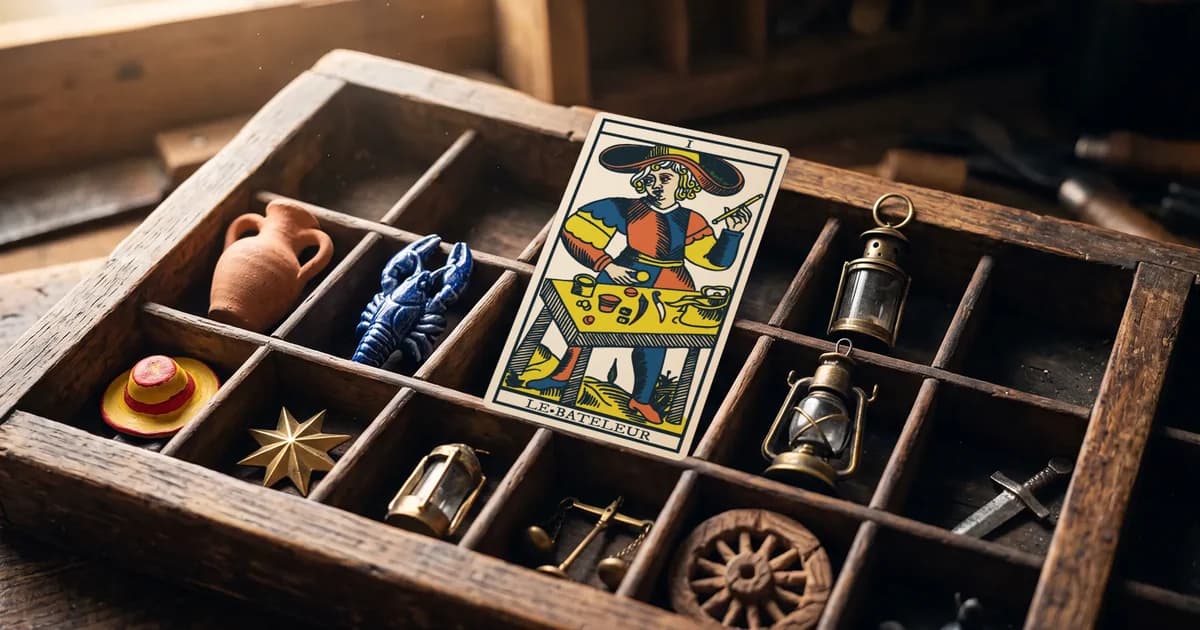
Tarot de Marseille symbols: 124 details explained, card by card
The Fool’s dog, the Magician’s hat, the 19 drops on the Moon. For each of the 22 major arcana: what is actually drawn, what the tradition reads in it, and what changes from one edition to the next, counted on a Conver-type deck.
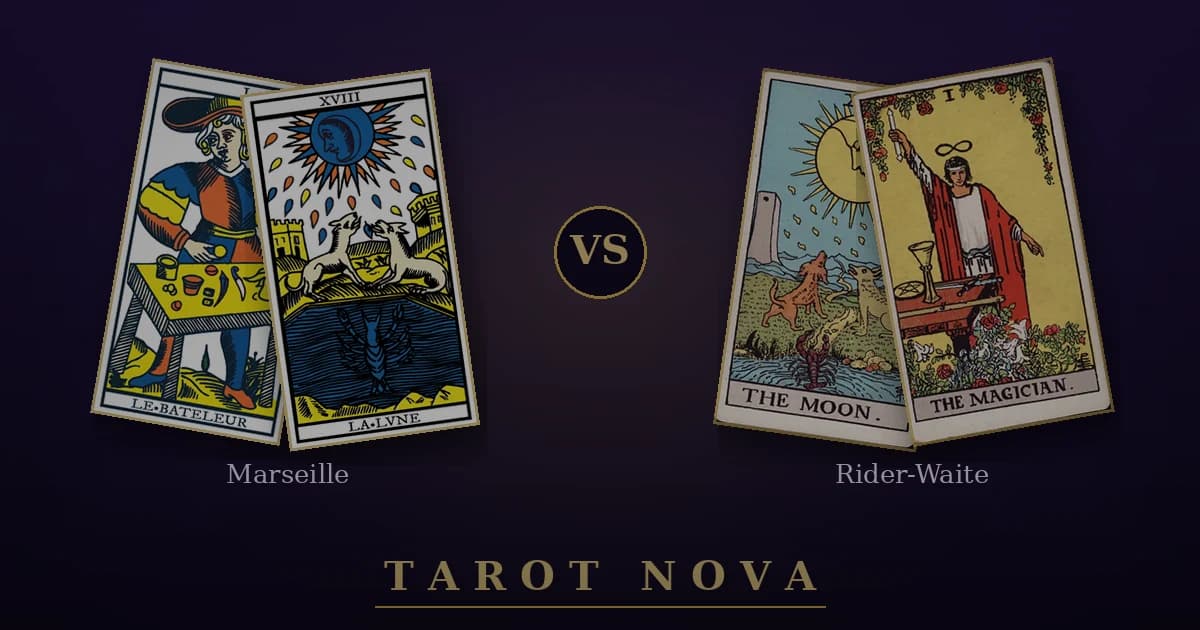
Marseille Tarot vs Rider-Waite: which one to choose?
Origins, key differences, a comparison table and advice by profile to choose between the two great tarot decks — with our admitted soft spot for Marseille.