
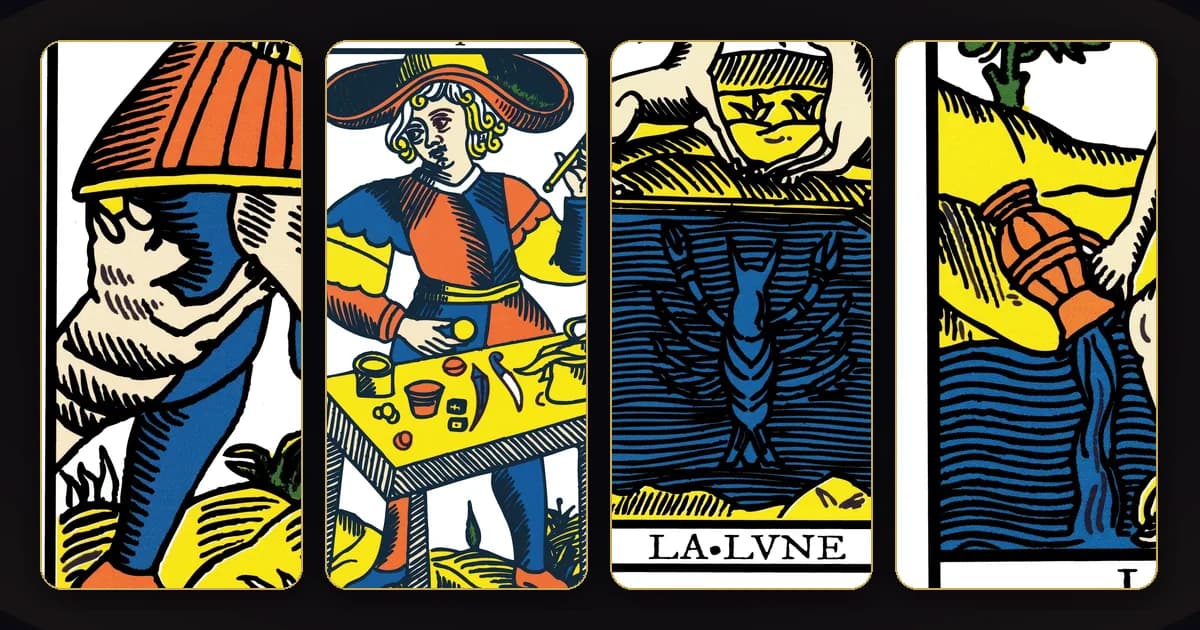
Tarot de Marseille symbolism
Illustrated dictionary of Tarot de Marseille symbols: 124 details, card by card
A Tarot de Marseille symbol is a drawn detail that carries meaning: the animal clawing at the Fool, the Magician’s hat, the drops beneath the Moon. People look them up one at a time; here they are gathered in one place. This dictionary lists 124 details across the 22 major arcana and gives three things for each one: what is actually drawn, what the tradition reads in it, and what changes from one edition to the next.
The descriptions follow the Conver-type reproduction (Marseille, 1760) used on TarotNova, the model behind the 1930 Grimaud and most decks in print today. The numbers (drops, spheres, stars, buttons) were counted on those images: they hold for this lineage, not for every tarot.
Published on September 26, 2026 · updated on September 26, 2026 · Stéphane Gamot
Key points
- A symbol is read in three steps: what is drawn, what the tradition reads in it, what changes with the edition. Skipping the first step is where most misreadings come from.
- On the Conver lineage, the Moon carries 19 drops, the Sun 13, the Tower 37 spheres, the Star 8 stars and the Hanged Man 12 cut branches. These numbers vary from one deck to another.
- The numerals are written the old way (IIII, VIIII, XIIII, XVIIII) and the titles use a V for the U: these are engravers’ conventions, not secret codes.
- Many famous readings (the Moon’s wolf, the Magician’s infinity sign, the Wheel’s sphinx) come from other decks or from 19th-century authors: they are useful, as long as you know where they come from.
- A detail predicts nothing. It gives you a sharper question to ask the card, and that is already a great deal.
How to read a symbol: look, read, compare
Reading a tarot symbol means answering three questions, in order: what is drawn, what does the tradition read in it, and what changes from one edition to the next. The first keeps you from inventing, the second gives you the shared meaning, the third keeps you from mistaking an engraver’s quirk for a law.
Look first. The Tarot de Marseille is a woodcut colored with stencils: a black line, four or five flat areas of color, no shading at all. Many details are born of that constraint. A shadow becomes a blotch, a piece of cloth becomes a flat patch of red, a fold becomes a line. Before looking for a meaning, describe what the eye sees, without naming it too soon.
Then read. The interpretive tradition was written late, between Court de Gébelin (1781) and the authors of the 20th century. That does not make it wrong: it is the shared meaning, the one your readings and your readers will have in mind. This dictionary gives it as it stands, and flags it when a reading comes from another deck, most often the Rider-Waite.
Finally, compare. Noblet (c. 1650), Dodal (c. 1701), Conver (1760), Grimaud (1930), Camoin-Jodorowsky (1997): every edition moves an object, changes a color, adds or removes a branch. When a detail exists in only one edition, it says something about the engraver, not necessarily about the tarot.
- Look: describe the detail without interpreting it. Where it sits on the card, what color, what size, which way it points.
- Read: recall what the tradition sees in it, and since when. An old meaning and a recent one do not carry the same weight.
- Compare: check whether the detail is stable from deck to deck. Stable, it belongs to the tarot; variable, it belongs to an engraver.
The reference deck for this page
The images and the counts come from the Conver-type reproduction shown on TarotNova’s card pages. When we write “on the card,” we mean that edition. When we write “depending on the edition,” we name the deck concerned. We counted only what can be counted without ambiguity; the Sun’s rays, cut off by the title band, are not included. One point of vocabulary: the red of this lineage is an orange-red. We write “red” when the tradition uses that name for a garment, a horse or a jug, and “orange” in the counts, where only the hue matters.
What we counted on the 22 cards
Some details are searched for with a number: how many drops, how many stars, how many buttons. The counts below were taken from TarotNova’s Conver-type reproduction, with the color of each element wherever it can be told apart.
| Detail | Count | Breakdown |
|---|---|---|
| Drops on the Moon (XVIII) | 19 | 8 blue, 6 orange, 5 yellow; all pointing toward the moon |
| Drops on the Sun (XVIIII) | 13 | 5 blue, 3 yellow, 3 white, 2 orange; all pointing toward the sun |
| Spheres on the Tower (XVI) | 37 | 13 orange, 13 white, 11 blue |
| Stars on the Star (XVII) | 8 | 1 large star with 16 points (8 yellow, 8 orange) and 7 small eight-pointed stars (3 yellow, 2 blue, 2 orange) |
| Cut branches on the Hanged Man (XII) | 12 | 6 on each trunk |
| Buttons on the Hanged Man (XII) | 9 | 3 on the yellow vest, 6 on the blue tunic |
| Spokes on the Wheel of Fortune (X) | 6 | around an orange hub, with a crank |
| Dice on the Magician (I) | 2 | one shows four pips, the other a single pip |
| Cards where green appears | 10 of 22 | Fool, Magician, Hierophant, Chariot, Hanged Man, Temperance, Tower, Star, Sun, Judgement; always in small touches (vegetation, two rays, a tomb, trefoils) |
These numbers are often quoted without a source, sometimes with other values. We counted them element by element, on screen, on the images of this lineage; a Noblet, a Dodal or a Rider-Waite gives other counts. If you reuse these figures, say which edition they come from.
The 22 cards and their details
The cards are in deck order, the Fool first because it has no number. Every detail has its own anchor: you can link straight to “the Fool’s dog” or “the Moon’s crayfish” from your notes, your classes or your articles.
The Fool: the traveler and his animal
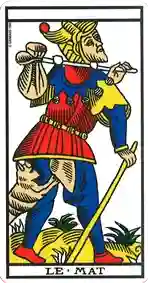
A man walks toward the right, a bundle at the end of a stick over his shoulder, a staff in his other hand. A flesh-colored animal clings to his thigh. There is no number in the band at the top: it is the only card in the deck without one.
The Fool’s animal, known as “the dog”
- On the card
- Behind the walker, a flesh-colored animal with no recognizable species rears up on its hind legs and claws at his thigh. Its mouth is open, its head raised toward him.
- How it is read
- Custom calls it a dog: the instinct that follows, pushes or holds back the traveler. Its flesh color, the same as the Fool’s skin, invites you to read it as a part of him rather than a companion: the thing in us that clings at the moment of leaving. Depending on the spread, it urges him on or holds him back.
- Across editions
- In Noblet (c. 1650), the breeches are torn open wider still and show the Fool’s genitals. In Conver, the animal only rips the cloth. The Rider-Waite (1909) turns it into a small white dog bounding along happily: the sense of warning disappears in favor of loyalty.
The torn breeches
- On the card
- Where the animal sets its paw, the blue breeches are torn open and show the skin of the thigh and buttock.
- How it is read
- The Fool is the only clothed figure in the deck whose body shows by accident. It is read as what leaving exposes: you set off with your clothes and your flaws, without time to mend everything. It is also the exact spot where instinct bites into the social costume.
- Across editions
- Plain nudity in Noblet; a tear in Conver; nothing of the kind in Waite, whose Fool is impeccable.
The bundle at the end of the stick
- On the card
- A closed beige bag, tied to the end of a stick resting on his left shoulder, on the viewer’s side. What it holds cannot be seen.
- How it is read
- Luggage cut down to the essentials: what you take when you do not know where you are going. Closed, it keeps its contents to itself; it is read as past experience, carried along without being unpacked. The psychological reading sees in it what the traveler carries without looking at it.
The walking staff
- On the card
- In the right hand, a yellow staff planted in front of him, longer than the stick holding the bag.
- How it is read
- Support. The Fool does not use it to strike but to feel the ground ahead: moving forward blind, yes, but with something to lean on. Yellow, the color of light, gives this staff the role of what lights one step at a time. Compare it with the Hermit’s lantern, which lights just as little, but from above.
The cap with bells
- On the card
- A yellow cap with a drooping point, ending in a red ball; bells hang from the collar of the garment.
- How it is read
- The costume of the court jester, the one who can tell the truth because nobody takes him seriously. The bell announces his passing: the Fool does not hide. This card is often read as freedom; the cap reminds you that this freedom has a social price, that of being taken for a fool.
The missing number
- On the card
- The upper band is empty. Every other card carries a Roman numeral there, from I to XXI.
- How it is read
- Without a number, the Fool has no fixed place in the sequence: it is put at the beginning (the starting point), at the end (after the World) or outside the series. Birth card calculation methods give it 22 for convenience. The Rider-Waite assigns it 0, which makes it a beginning and closes the debate the Marseille leaves open.
The Magician: the table and its objects
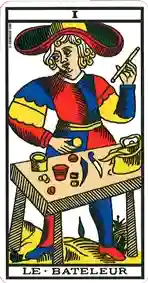
A young man stands behind a table covered with objects, a wand raised in one hand, a coin in the other. His wide hat, his three-colored clothes and his table standing on three visible legs draw most of the readings.
The hat, known as the “lemniscate”
- On the card
- A hat with very wide, upturned brims, whose outline traces a double loop lying on its side. It is colored in three zones: orange, blue, yellow.
- How it is read
- The most widespread reading sees in it the infinity sign (the lemniscate), and so an energy without limit at the moment of beginning. That reading came after the fact: the word and the mathematical symbol date from the 17th century, and it was the Rider-Waite that drew an explicit ∞ above its Magician’s head. On the Marseille, the hat remains a hat; you can read in it the breadth of what is possible, or simply the outfit of a fairground performer.
- Across editions
- The same double-loop hat sits on Strength (XI): the two cards answer each other, I and XI, the gesture that begins and the gesture that masters.
The three-legged table
- On the card
- The yellow table has only three visible legs; the fourth, on the right, runs out of the frame or does not exist.
- How it is read
- The most discussed detail on the card. It is read as what is missing at the beginning: the plan is there, the materials are there, but the work does not yet have its fourth support, the one that will come from labor. Others see a table that spills out of the frame, and so a job bigger than what the picture shows. Both readings say the same thing: the Magician is not finished.
- Across editions
- Three legs in Noblet, Dodal and Conver. Waite’s Magician has a four-legged table, firmly planted, and loses that reservation.
The cups and the dice
- On the card
- Two cups (a large one at the back, a red one in the center) and two dice: one shows four pips in a cross, the other a single pip.
- How it is read
- The tools of the sleight-of-hand trick: the Bateleur, as the engraved title calls him, is first of all a fairground conjurer, the one who makes a ball vanish under a cup. The dice add chance. This kit is read as what you own at the start, skill and luck, and the risk of using them to deceive. The visible pips, 4 and 1, have been read as a 5 (the number of card V, the Hierophant, or of the hand at play); that is a reading, not a proven intention of the engraver.
The knife
- On the card
- On the table, a blue blade with a dark handle, and beside it a second slender object, white and blue, which may be a sheath or another knife.
- How it is read
- The tool that cuts: what lets you separate, decide, divide the work into stages. On this table, it is the ancestor of the sword of the minor arcana. Put away among the other objects, it threatens no one: it is an instrument, not a weapon.
The wand, the coin, the cup, the knife: the four suits together
- On the card
- The Magician holds a wand in one hand and a yellow coin in the other; on the table, cups and a knife. The four suits of the minor arcana are present: wands, coins, cups, swords.
- How it is read
- The classic reading: at the beginning, every means is available, and nothing has been chosen yet. Each object calls for a question: what will I act with (wand), what will I pay with (coin), what do I feel (cup), what do I cut (sword). The bag set at the edge of the table keeps what has not yet come out.
- Across editions
- Waite lays the four emblems neatly on the table, one per suit. The Marseille mixes them in the clutter of a stall: the difference between a ritual and a trade.
The plant between his feet
- On the card
- On the yellow ground, between the Magician’s legs, a small green shoot; other tufts to the right.
- How it is read
- Green is rare in the deck: wherever it appears, something is growing. Under the table of beginnings, a shoot says the ground is fertile, and that what is started here will grow if it is looked after.
The High Priestess: the book, the veil and the tiara
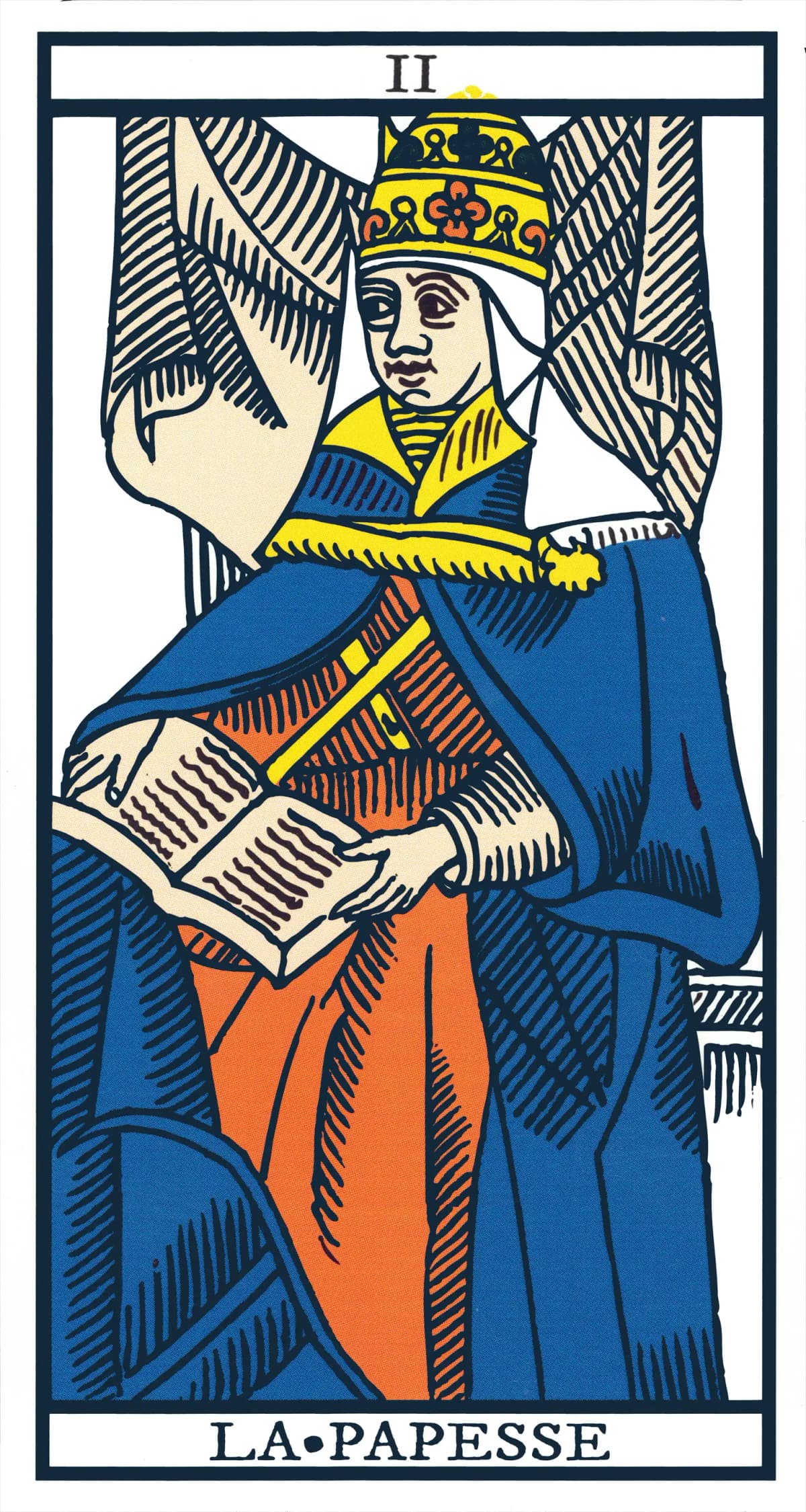
A seated woman, wearing a tiara, holds an open book on her lap. A pale veil falls behind her. Her blue cloak covers almost everything; neither her feet nor any ground can be seen. The engraved title is LA·PAPESSE, “the Popess”; the usual English name, the High Priestess, comes from the Rider-Waite.
The open book
- On the card
- An open book, its pages covered with wavy lines that form no legible word, held with both hands on her lap.
- How it is read
- Knowledge that is read, as opposed to knowledge that is shown. The illegible lines are part of the meaning: what is written there cannot be read from outside. The High Priestess knows and does not yet say; the open book signals that she is still learning, not that she has finished. In a reading: a piece of information exists, but it is not yours yet.
- Across editions
- In Waite, the High Priestess holds a scroll marked TORA, half hidden under her cloak: the book becomes a law.
The veil behind her
- On the card
- A pale, pleated cloth falls behind her shoulders and fills the background of the card on the right and the left.
- How it is read
- What separates inside from outside. The veil hides what lies behind the High Priestess, and so what she protects: an inner space, a reserve, a legitimate secret. The color reading adds that this veil is the color of paper, and so of the page not yet written.
- Across editions
- Waite stretches the veil between two pillars marked B and J, borrowed from Solomon’s Temple; the Marseille has neither letters nor pillars, only the cloth.
The three-tiered tiara
- On the card
- A yellow headdress with three crowns stacked one above the other, the same as the Hierophant’s (V), set over a white veil.
- How it is read
- The papal tiara: the highest spiritual authority, worn here by a woman. The legend of Pope Joan fed the image. The three tiers are read as three levels of knowledge, or three worlds; what matters is that this headdress is shared with the Hierophant. She reads; he speaks.
The blue cloak that covers everything
- On the card
- A blue cloak wraps the body from neck to feet, leaving visible only a red dress underneath and the hands. No ground, no feet.
- How it is read
- Blue covers red: reflection contains impulse. The High Priestess is the most closed card in the deck, and that is her strength; nothing escapes, nothing is exposed. The absence of ground reinforces the impression of an inner place, with no outside.
The Empress: the eagle, the scepter and the throne
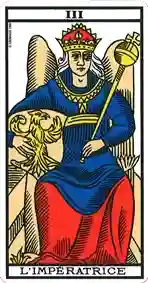
A crowned sovereign, seated, holds a scepter in one hand and a shield bearing an eagle in the other. The back of her throne spreads out behind her like two pale wings.
The eagle on the shield
- On the card
- A yellow eagle, wings spread, head turned to the right, and so toward her, on a beige shield the Empress holds against her hip.
- How it is read
- The eagle is the imperial emblem: the overview, the height, the power that sees far. Held like a shield, it protects as much as it displays. The Empress is read as the intelligence that conceives and names; the eagle is her gaze.
- Across editions
- The same eagle appears at the foot of the Emperor’s throne (IIII), its head turned to the left. Set the two cards side by side, III then IIII: the two eagles look at each other.
The scepter with orb and cross
- On the card
- A long yellow scepter, topped by a sphere surmounted by a cross, held in the left hand and resting against the shoulder.
- How it is read
- The globus cruciger, the insignia of Christian sovereigns: power over the world, under a higher authority. The Empress holds it loosely, against her shoulder: a power she has at her disposal without needing to brandish it.
The crown
- On the card
- A yellow crown with pointed finials, with a red cap inside it, over fair hair.
- How it is read
- The sovereignty of thought: the Empress rules by what she understands. The red beneath the yellow is read as ardor contained by the light of the mind. The site’s glossary covers the crown as a symbol in detail.
The wing-shaped backrest
- On the card
- Behind her, two pale, striated shapes rise on either side, like two wings or the uprights of a throne.
- How it is read
- Wings or throne, the drawing does not settle it, and the ambiguity makes sense: the Empress is seated, and so stable, but her throne has the shape of something that takes flight. It is read as a thought that rises without leaving its seat.
The Emperor: the crossed legs and the throne
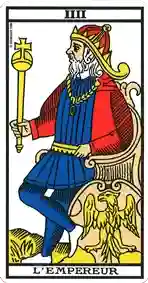
A bearded sovereign, seen in profile and turned to the left, holds a scepter and leans against a throne bearing an eagle. His legs are crossed; it is hard to say whether he is sitting or standing.
The legs crossed in a 4
- On the card
- The left leg passes in front of the right and forms, with it, the outline of a 4. The card bears the number IIII.
- How it is read
- The body writes the card’s number: it is the most quoted detail of the Emperor. Four is the number of the frame, the square, what holds; crossing the legs this way closes a base. It is read as stability, but also as a posture that does not allow running: the Emperor holds, he does not move.
- Across editions
- The Hanged Man (XII) also crosses his legs, head down, and the World (XXI) raises a leg in the same position, right side up. The three cards are read as a series.
Seated without sitting
- On the card
- The throne is behind him, but his pelvis does not rest squarely on it: he seems to be leaning back against it, ready to rise.
- How it is read
- Authority in action, not at rest. The Emperor does not sit enthroned like the High Priestess or Justice; he governs standing, or nearly so. It is read as an active power that administers, and as a difficulty settling down.
The eagle at the foot of the throne
- On the card
- A yellow eagle, wings open, its head turned to the left like the Emperor’s, drawn on the lower part of the throne, at leg height.
- How it is read
- The same emblem as the Empress’s, but placed low and turned in the direction of the Emperor’s gaze, to the left, that is, toward the past by the reading convention. The Emperor sets his eagle’s eye on the ground and on what has been built: he looks at the territory, not the sky.
The chain and the medallion
- On the card
- A yellow chain goes around the neck and falls onto the chest, ending in a dark medallion.
- How it is read
- The collar of an order, a badge of belonging: the Emperor is bound by what he represents. A chain, even a gold one, is still a chain; some read in it the weight of office.
The scepter with orb and cross
- On the card
- A yellow scepter identical to the Empress’s, held upright in the right hand, at face height.
- How it is read
- Held vertical and firm, where the Empress let hers rest: the same insignia, another use. The Emperor brandishes; the Empress has it at her disposal. That is the difference between deciding and conceiving.
The Hierophant: the cross, the glove and the two acolytes
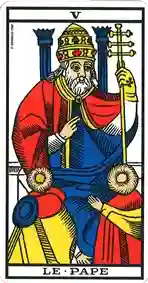
A bearded man wearing the tiara raises two fingers in blessing and holds a cross with three crossbars. In front of him, two figures seen from behind, their heads tonsured. Two blue columns frame the scene. The engraved title is LE·PAPE, “the Pope”; the usual English name, the Hierophant, comes from the Rider-Waite.
The cross with three crossbars
- On the card
- In the left hand, a yellow cross whose staff carries three horizontal bars, growing longer toward the bottom.
- How it is read
- The papal cross, with three crossbars as the tiara has three tiers: the authority that teaches, on three levels. It is read as structured transmission, a doctrine, a framework. The Hierophant is the card of what is said, taught and used as a reference.
The glove marked with a cross
- On the card
- The hand holding the cross wears a yellow glove, with a small dark cross on the back.
- How it is read
- The glove separates the hand from the sacred object: the Hierophant does not directly touch what he passes on. It is read as mediation, the role, what comes between a person and their function. The other hand, bare, gives the blessing: what is human stays uncovered.
The two tonsured acolytes
- On the card
- Two smaller figures seen from behind, the crowns of their heads marked with a round tonsure; one wears a skullcap, the other raises a hand toward the Hierophant.
- How it is read
- Those who receive the teaching. Seen from behind, they put the reader in their place: it is you the Hierophant is speaking to. The tonsure says commitment to a rule. This pair of pupils is read as transmission, but also as dependence on the one who knows.
- Across editions
- Waite keeps the two monks, adds two crossed keys on the ground and makes his Hierophant a more rigid figure.
The two blue columns
- On the card
- Two blue columns, with capitals, rise behind the Hierophant’s shoulders up to the top edge.
- How it is read
- The institution: the Hierophant speaks inside a building. The columns are blue, the color of reflection, not yellow: the framework is there, but it does not shed light by itself. Together with the four columns of the Chariot’s canopy, they are the only columns in the deck; behind the High Priestess, a veil stands in for them.
The gesture of blessing
- On the card
- The right hand, bare, is raised to shoulder height, index and middle fingers extended, the other fingers folded.
- How it is read
- The sign that validates: “this is right, you may.” In a reading, the Hierophant blesses what has been undertaken, or signals that an agreement, a permission, a recognition is at stake. Two fingers extended, two acolytes, two columns: the card repeats the number 2 beneath the number 5.
The Lovers: Cupid, the three figures and the singular title
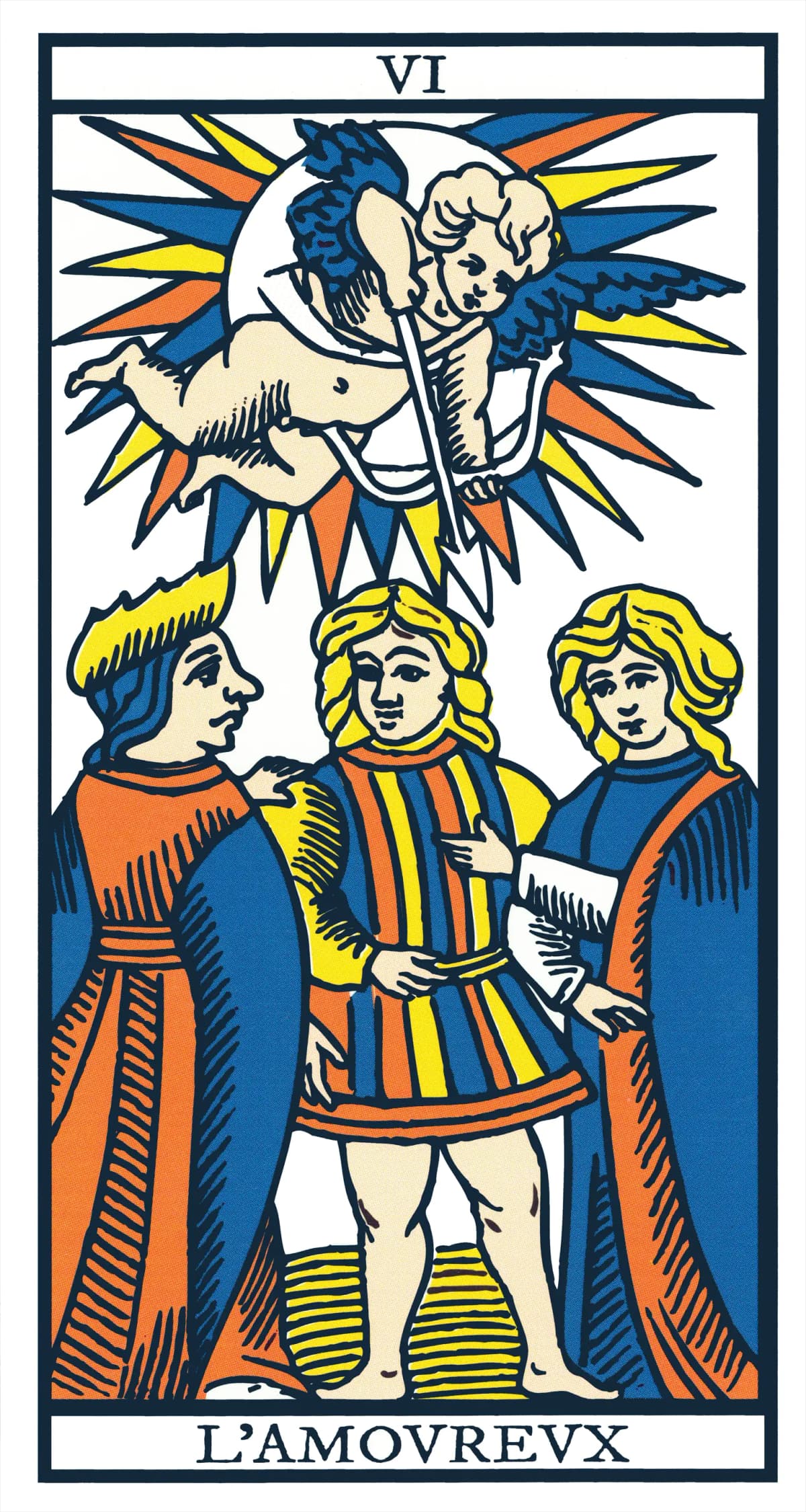
A barefoot young man stands between two women who are touching him. Above, a winged Cupid draws his bow inside a white sun. The engraved title is L’AMOVREVX, in the singular: “the Lover.”
The singular title
- On the card
- The band reads L’AMOVREVX: one lover, not two.
- How it is read
- The Marseille does not show a couple but a man who is choosing. The title confirms it: the card is about the choice, not the union. The plural, “The Lovers,” standard in English today, comes from the Rider-Waite and its two nude figures beneath an angel. The site keeps the plural for its card pages; the engraving, for its part, says the singular.
Cupid and his arrow
- On the card
- Inside a white disk with blue, yellow and red rays, a naked, winged child draws a bow; the arrow points downward, toward the woman on the left.
- How it is read
- Desire comes from above and is not up for discussion: Cupid takes aim, the figure does not decide what he feels. The arrow pointing to the left has been read as a choice the heart has already made, before the head has spoken. The sun behind him makes that desire visible to everyone.
- Across editions
- Waite replaces Cupid with the archangel Raphael, hands open, without a bow: desire becomes blessing.
The three figures
- On the card
- In the center, a young man in a striped tunic; on the left, a woman crowned with leaves, her hand on his shoulder; on the right, a woman with loose hair, one hand reaching toward his hip. He points to her with his hand while looking at the other.
- How it is read
- The classic reading sets two paths against each other: the woman crowned with leaves (the elder, tradition, the mother) and the young woman with her hair down (desire, novelty). The young man looks at one and points to the other. The dilemma is drawn in his posture: it is read as any choice where the head and the body do not agree.
The bare feet
- On the card
- The young man is the only one of the three with bare feet, set on the yellow ground; both women are clothed down to the ground.
- How it is read
- Direct contact with the ground: he is physically committed to the situation, exposed. Bare feet, in this deck, belong mostly to the naked figures, who no longer have a role to play (the Star, the Sun, Judgement, the World). Here, they say a sincerity that has not yet made up its mind.
The crown of leaves
- On the card
- The woman on the left wears a crown of yellow leaves; the woman on the right has nothing on her head.
- How it is read
- The laurel of the one who has already won: precedence, legitimacy, what was there before. Facing her, the other woman’s loose hair says what has not yet been framed. The card’s choice is often read this way: between what is secured and what attracts.
The Chariot: the canopy, the horses and the letters S·M
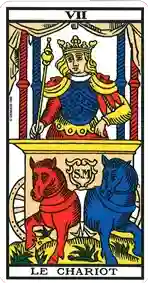
A crowned prince, scepter in hand, stands in a canopied chariot drawn by two horses, one red, the other blue. He has no reins. On the front of the chariot, a small shield bears two letters.
The letters S·M on the shield
- On the card
- On the front of the chariot, a small shield carries the letters S and M, separated by a dot.
- How it is read
- Nobody knows for certain what they mean. The hypotheses range from a cardmaker’s initials to a Latin or devotional abbreviation; none of them is established by any document. It is a good example of a detail not to over-interpret: two letters you do not understand are not a coded message, they are two letters you do not understand.
- Across editions
- They appear on the Conver and its descendants; other editions carry other letters, or none at all. Waite replaces the shield with a winged disk.
The two horses, red and blue
- On the card
- Two horses seen in three-quarter view, one orange-red, the other blue, whose bodies merge behind the shield as if they were a single animal. The red one lifts a leg, the blue one looks to the side.
- How it is read
- Two opposing forces harnessed to the same chariot: impulse (red) and reflection (blue), desire and reason. They are not looking in the same direction, and yet the chariot moves forward. It is read as a success that depends on getting what pulls every which way to pull together.
- Across editions
- Waite replaces the horses with two sphinxes, one black and one white, sitting down: the forces are tamed and motionless, where those of the Marseille are alive and on the move.
The missing reins
- On the card
- The driver holds a scepter in one hand and rests the other on his hip. No reins connect his hands to the horses.
- How it is read
- The chariot is not steered by force but by posture: the prince drives by standing straight. It is the most useful reading of the card: mastery that does not go through constraint. The downside is obvious: without reins, stopping is not easy.
The canopy and its four columns
- On the card
- A pale canopy, edged with pleated cloth, rests on four twisted columns, alternating red and blue.
- How it is read
- A portable sky: the Chariot carries its framework with it. Four columns, like the four corners of a territory or the four living creatures of the World: the card gives itself a complete structure in order to move forward. The canopy also protects: the prince is sheltered from what falls from above.
The crescent-shaped epaulettes
- On the card
- On each shoulder, a yellow piece of armor shaped like a crescent, turned outward.
- How it is read
- Many editions draw two faces there, one smiling, the other grave; here, the shape remains a crescent without features. The “masks” reading sees in them the two faces the prince shows the world, or the two moons framing the sun of his crown. On this reproduction, keep to the shape: two protected shoulders, turned outward.
- Across editions
- Distinct faces on several Conver decks and on the Grimaud; two lunar crescents on the shoulders of Waite’s Chariot.
The wheels seen head-on
- On the card
- The two wheels are drawn face-on, flat, although the chariot is seen from the front: an impossible perspective.
- How it is read
- The engraver shows the wheels so that we know they exist, not so that they turn. Movement is read here as a principle more than a fact: the Chariot is the card of moving forward, but nothing proves it is moving at the moment you look at it. In a spread, the question becomes: is it really rolling?
Justice: the scales, the sword and the frontal gaze
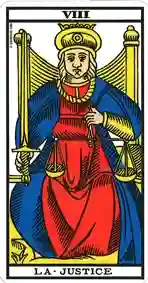
A seated woman, seen from the front, looks at the reader. She holds a set of scales in her left hand and an upright sword in her right. Two yellow uprights rise behind her.
The number VIII
- On the card
- The band reads VIII. In the Rider-Waite, Justice carries the number 11 and Strength the number 8.
- How it is read
- The swap dates from 1909: A. E. Waite followed the Golden Dawn’s order so that the cards would match the signs of the zodiac. On a Marseille, Justice is the eighth card, between the Chariot and the Hermit: the balance that follows the conquest. Any calculation based on the numbers (birth card, personal year) depends on this choice.
The scales
- On the card
- A yellow pair of scales with two pans, held by the beam in the left hand, at waist height. The pans are level.
- How it is read
- Weigh before you cut: the instrument of measure. The level pans say the weighing is done, or that neither side has won yet. The scales are read as the share of evaluation in every decision, and the need to compare before concluding.
The upright sword
- On the card
- A yellow sword, held vertical in the right hand, point in the air, the hilt at knee height.
- How it is read
- Cut, after weighing. Upright and motionless, the sword does not strike: it is ready. It is read as the clean decision, the limit set, the end of an ambiguity. The glossary covers the sword as a symbol in detail.
The frontal gaze
- On the card
- Justice is one of the few cards that look the reader straight in the eye, the face perfectly frontal.
- How it is read
- Nothing to hide, nothing to flee. The frontal gaze puts the person drawing the card in the position of being judged, or of judging. By the left-past / right-future convention, a frontal gaze speaks of the present: the decision is now.
The disk at the center of the crown
- On the card
- In the middle of the crown’s yellow band, on the forehead, a small circle with a double outline and a dot at the center.
- How it is read
- Read as a third eye, a sun or a jewel: the higher vantage point that makes judgment possible. The reading stays open; what is certain is that this circle sits at the exact center of the most symmetrical card in the deck.
The twisted cord at the neck
- On the card
- Around the neck, a thin twisted yellow cord, knotted on the chest.
- How it is read
- A necklace or a rope, the line does not settle it. The soberest reading: an ornament of office, like the Emperor’s chain. The harsher reading: Justice is herself held by what she applies. Both hold up; choose the one the spread calls for.
The Hermit: the lantern, the staff and the cloak
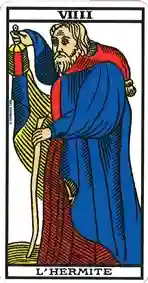
An old bearded man, wrapped in a blue cloak lined with red and yellow, walks toward the left. He raises a lantern in one hand and leans on a staff with the other.
The lantern
- On the card
- A red, paneled lantern, held at face height; a yellow glow escapes from it. The flap of the blue cloak falls just behind it, without covering it.
- How it is read
- The light you carry yourself. The Hermit lights just enough for the next step, and keeps it close to him, against the cloak: he is not trying to light the way for others, or not yet. It is read as patient discernment, searching, the period when you understand without being able to explain.
- Across editions
- On several old Marseille decks, a flap of the cloak half veils the lantern; here, it is uncovered. Waite puts a six-pointed star inside the lantern and has it held out at arm’s length: the light is offered instead of kept.
The staff
- On the card
- A beige staff, slightly curved, held in the left hand and planted in front of him.
- How it is read
- Support and rhythm: the old man does not run, he sets his staff down at every step. Compared with the Fool’s, this staff is dull and knotted: the same function, but after use. It is read as method, endurance, what holds when light is lacking.
The blue cloak lined with yellow
- On the card
- A large blue cloak covers the body; its yellow lining shows where it lifts, on the lantern side. Underneath, a red and orange robe.
- How it is read
- Reflection (blue) on the outside, light (yellow) on the inside, ardor (red) deepest of all. The Hermit is the opposite of his appearance: a flame under a cloak. It is the card of those who are thought to have gone out, and who have not.
The gaze toward the left
- On the card
- The Hermit walks and looks toward the left of the card; his lantern shines in that direction.
- How it is read
- By the reading convention, the left is the past: the Hermit examines what has been, he takes stock. This is not a step backward, it is an inventory. The card answers well to questions of the kind “what have I learned from what happened.”
The Wheel of Fortune: the crank, the three creatures and the sphinx
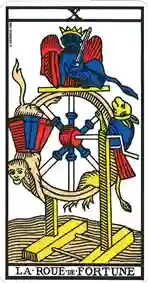
A six-spoked wheel, mounted on a yellow stand set on blue ripples, carries three creatures: one goes down on the left, another climbs on the right, the third sits enthroned at the top, crowned, winged, a sword in hand. A crank sticks out of the axle.
The crank
- On the card
- To the right of the axle, a white crank comes out of the orange hub; nobody is holding it.
- How it is read
- The wheel can be turned: the cycle is not only something you suffer. That the crank is free is the detail that counts. It is read as the share of leverage you may have over a situation that is turning, and the question it imposes: who has their hand on it, right now?
- Across editions
- No crank in Waite, whose wheel floats in the sky, covered with Hebrew and alchemical letters: the mechanism becomes a mandala.
The three creatures
- On the card
- On the left, a creature with a human face and a tail goes down, head first; on the right, a creature with a yellow animal head climbs; at the top, a blue beast, crowned and winged, holds a sword, seated on a plank.
- How it is read
- Rising, falling, reigning: the three positions of the cycle. The one going down keeps a human face, the one climbing has an animal head: you do not rise without losing a little of your face, you do not fall without finding it again. The reading stays open on the identity of the beasts; their positions are enough to make the card.
The creature at the top, known as the “sphinx”
- On the card
- A blue beast with an animal body, orange wings, a yellow crown and a sword, installed on a plank above the wheel, does not turn with it.
- How it is read
- Custom calls it a sphinx, under the influence of the 19th-century occultists and of the Rider-Waite, which made it a real sphinx. On the Marseille, it is an indeterminate creature, crowned and armed: what stays stable while everything turns, and what judges. In a spread, it raises the question of the fixed point: in the name of what is all this turning?
The six spokes
- On the card
- The wheel has six white spokes, with blue bulges, around an orange hub.
- How it is read
- Six is the number of cards in one full turn (I to VI) and twice three: it is read as the measure of the cycle rather than as a code. What counts is that the wheel is divided: each position has its place, and none of them lasts.
The stand set on the water
- On the card
- The wheel’s yellow support rests on wavy blue lines that fill the whole bottom of the card.
- How it is read
- The wheel turns above water, the color of emotion and of the unconscious: the cycles of life rest on what moves inside us. The stand is yellow, and so lucid; it holds on a ground that is not one. A good card for asking what the thing that is turning actually rests on.
Strength: the hat, the lion’s jaws and the dress
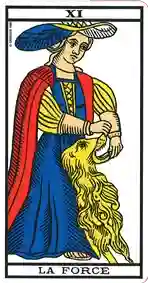
A standing woman, wearing a wide hat, holds with both hands the mouth of a yellow lion that seems to come out of her dress. Her face is calm, her eyes lowered toward the animal.
The number XI
- On the card
- The band reads XI. In the Rider-Waite, Strength carries the number 8.
- How it is read
- The same swap as for Justice, decided by Waite in 1909 after the Golden Dawn. On a Marseille, Strength opens the second half of the deck, right after the Wheel: what takes back control once the cycle has turned. The two cards, VIII and XI, form a pair: weighing and cutting on one side, holding and taming on the other.
The double-loop hat
- On the card
- A hat with wide upturned brims, blue and yellow, whose outline repeats that of the Magician’s hat.
- How it is read
- Strength wears the same hat as the Magician (I): the two cards are the only ones in the deck with this headgear, and their numbers answer each other (1 and 11). Where he begins, she masters. The “infinity” reading therefore applies to both, with the same reservation: it is a hat, whose shape was reinterpreted after the fact.
- Across editions
- Waite places an ∞ above the head of his Strength, bareheaded and crowned with flowers: the loop of the hat becomes an explicit sign.
The hands on the lion’s jaws
- On the card
- One hand rests on the lion’s upper jaw, the other under the lower jaw. The mouth is open.
- How it is read
- Is she opening the mouth or closing it? The drawing does not let you decide, and that is the card’s question. Opening: giving instinct a voice, letting it speak under control. Closing: containing it. Most modern readings keep the gentleness of the gesture: no whip, no sword, two bare hands on a wild beast. Strength here is a relationship, not a victory.
The lion coming out of the dress
- On the card
- The lion’s body is not fully visible: its mane and paws emerge from the bottom of the blue dress, as if it were coming out of it.
- How it is read
- The beast is not in front of her, it comes from her. Instinct is read as a part of the self, not as an outside enemy; the same key as for the Fool’s animal. The blue dress (reflection) contains the yellow lion (energy): the card draws a consciousness that lets the drive through without letting go of it.
The lowered gaze
- On the card
- The face is tilted toward the lion; the eyes look at the animal, not at the reader or the horizon.
- How it is read
- Her whole attention is on what she is holding. Strength looks neither behind nor ahead: she is in the gesture. In a reading, the card invites you to concentrate on what is in your hands rather than on the result.
The Hanged Man: the tied foot, the legs in a 4 and the twelve branches
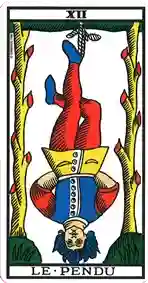
A young man hangs head down, by one foot, from a crossbeam set on two trunks stripped of their branches. His legs are crossed, his hands hidden behind his back, his face serene.
The foot tied to the rope
- On the card
- A rope fastened to the crossbeam grips the ankle of one foot; the other leg is free and bent.
- How it is read
- He hangs by a single point, and that point is enough. The tied foot is read as the commitment or the constraint that immobilizes: whatever is holding you right now. The card’s useful question: where are you held, and did you choose it?
The legs crossed in a 4
- On the card
- The free leg passes behind the tied leg and forms an upside-down 4, the same as the Emperor’s legs.
- How it is read
- The seated Emperor makes a 4 the right way up; the Hanged Man makes the same one upside down. The frame is the same, the position is reversed: stability becomes suspension. This figure is read as a structure that still holds, but turned over: the order of things seen from below.
- Across editions
- The World (XXI) takes up the same raised leg, right side up and in motion. IIII, XII, XXI: three states of a single posture.
The hands behind the back
- On the card
- The arms are folded behind the back; neither the hands nor whatever they hold can be seen.
- How it is read
- The Hanged Man cannot act, or does not want to. The hidden hands say waiting, the halt of direct action. Some old tarots put two purses in his hands, with coins falling out: what you lose while waiting, or what you let go of.
- Across editions
- On certain tarots earlier than the Marseille lineage, such as the so-called Charles VI tarot (late 15th century), the Hanged Man holds two purses from which coins fall; nothing of the kind on this reproduction. Waite’s Hanged Man has his arms crossed behind him and a halo around his head.
The twelve cut branches
- On the card
- Each yellow trunk carries six branch stumps, with red cut ends: twelve in all, as many as the card’s number.
- How it is read
- The trees have been pruned: what was growing was cut to hold up the crossbeam. It is read as what stillness costs, and also what it prepares: pruning comes before regrowth. The count of twelve, equal to the number, is stable on the Conver lineage and gives the card one of its rare verifiable hidden numbers.
- Across editions
- The number of stumps varies from deck to deck; count before you read twelve.
The nine buttons
- On the card
- Three buttons on the yellow vest, six on the blue tunic, in a single vertical line.
- How it is read
- A carefully buttoned garment, on a man hanging head down: he did not fall there, he got ready for it. Numerical readings see in it the 9 of the Hermit; what we mainly keep is the order: the Hanged Man is a tidy man in a situation that is not.
The two green mounds
- On the card
- At the foot of the trunks, two dark green mounds, one on the left, the other on the right; the Hanged Man’s head comes down between them, without touching them.
- How it is read
- The green of what grows frames the void where the head hangs. The ground is not reached: the Hanged Man is between above and below, with no support. The mounds are read as life going on around the one who has stopped.
Arcanum XIII: the scythe, the heads and the shoots
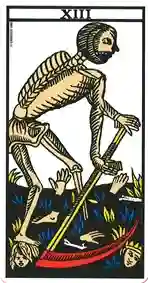
A flesh-colored skeleton, turned to the right, wields a scythe with an orange blade over black ground strewn with heads, hands, feet and bones. Blue and yellow shoots rise from that ground. The title band is empty; the site’s English pages call the card Death, after the Rider-Waite.
The missing name
- On the card
- The lower band, where the other cards carry their title, is empty. Only the number XIII is engraved.
- How it is read
- The only card in the deck without a title. That silence is read as a refusal to name what is nonetheless drawn: the end, the cut, death. Not naming it makes it a process rather than a person. The site devotes a full article to this question.
- Across editions
- Noblet writes LA MORT; Conver leaves it empty; Waite writes DEATH. The choice of silence belongs to the 18th-century Marseille lineage.
The scythe
- On the card
- A scythe with a yellow handle and an orange blade, held with both hands, its point touching the ground at the bottom of the card.
- How it is read
- The tool of the harvest, not of war: you mow what is ripe. The orange blade, the color of action, says the cutting is under way. It sweeps toward the right, in the direction the skeleton is walking: what is cut lies ahead of it, not behind.
The two heads on the ground
- On the card
- At the bottom right, a crowned head; at the bottom left, a head with fair hair. They look on, their eyes open.
- How it is read
- The cut spares neither kings nor anyone else: the crowned head has been saying so since the Middle Ages. That the heads keep their eyes open is rarer: what has been cut goes on looking. These heads are read as the roles and identities you part with, and which do not disappear right away.
The scattered hands and feet
- On the card
- Two open hands rise from the ground, a third lies flat; a bare foot and bones are scattered about.
- How it is read
- Hands still rising, a foot that no longer walks: what acted and what moved forward, separated from the body. Readings see in them past gestures and past paths. Nothing is buried: everything stays visible on the surface of the black ground.
The blue and yellow shoots
- On the card
- On the black ground, flame-shaped tufts, blue and yellow, grow between the remains.
- How it is read
- The detail that turns the card around: on the ground of the cutting, something is growing. Not green, as on the other cards, but blue and yellow, the colors of the inner world and of light. It is read as what grows back after an ending, in another form.
The flesh still on the bones
- On the card
- The skeleton is not white: it is flesh-colored, and patches of skin remain visible at the hips and pelvis.
- How it is read
- This skeleton is alive: it has the same skin color as the other figures. The remaining flesh is read as a transformation that is not finished, or as a sign that what cuts is also a part of the self. That is what sets XIII apart from an image of death: an active figure, not a figure of terror.
Temperance: the two vessels, the horizontal water and the flower on the forehead
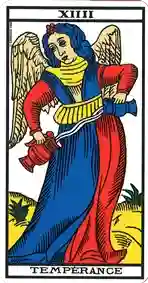
An angel with pale wings, standing, pours water from a blue vessel into a red one. The water flows sideways, without falling. A red flower is tucked into the angel’s hair.
The two vessels
- On the card
- A blue vessel held high, on the right, and a red vessel held low, on the left; the contents pass from one to the other.
- How it is read
- Two containers, two colors, a single flow: the card speaks of the passage between two poles. Blue to red, from reflection to action, or the reverse depending on which way you read the current. It is read as mixing, measuring out, what circulates between two people or two parts of the self.
The water that flows horizontally
- On the card
- The stream of water, white edged with blue, goes from one vessel to the other sideways, almost flat, without obeying gravity.
- How it is read
- The impossible detail on the card, and so the most read: this water does not fall because it is not ordinary water. It is seen as circulation without loss, exchange without waste, or an inner state where things pass without falling. It is an image of regulation, not of miracle: the gesture is continuous.
- Across editions
- Waite keeps the slanting flow, but sets one of the angel’s feet in the water and the other on land, and adds a sun and a path: the card becomes a landscape.
The red flower on the head
- On the card
- A red, five-petaled flower, set in the blue hair at the top of the head, on the left side.
- How it is read
- A thought in bloom: what opens at the level of the head. The red on the blue of the hair marks a life breaking through reflection. Read together with Justice’s circle, it belongs to the signs placed on the heads of the cards in the middle of the deck.
- Across editions
- The 1930 Grimaud sets the flower in the middle of the forehead, hence the expression “the flower on the forehead”; here, it is in the hair. Waite places a sun on his angel’s forehead.
The wings
- On the card
- Two pale, striated wings, spread behind the shoulders; the angel stands on the yellow ground, between tufts of green.
- How it is read
- The first angel in the deck, before those of Judgement and the World. The wings say that it could leave and that it stays: Temperance has its feet on the ground and the sky at its back. The card is read as a mediation between two levels, which makes it valuable in spreads about conflict.
The Devil: the wings, the antlers, the pedestal and the ties
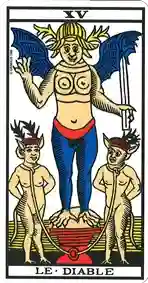
A figure with bat wings, stag’s antlers and a body both female and male stands on a pedestal. Two small devils, tied to the pedestal by a rope, stand on either side, hands behind their backs.
The bat wings
- On the card
- Two blue, membranous wings, with visible fingers, spread behind the shoulders.
- How it is read
- Temperance’s wings were made of feathers; the Devil’s are made of skin. The same ability to fly, another nature: the bat flies at night and finds its way without seeing. It is read as a real but nocturnal power, one that acts without light. In a reading: what carries you without your seeing it.
The stag’s antlers
- On the card
- Two yellow, branching antlers rise from the yellow hair on either side of the head. The two imps wear them too.
- How it is read
- Not a goat’s horns but a stag’s antlers, which grow and are shed every year: an animal power, seasonal, that grows back. It is read as instinct renewing itself, and as the kinship between the master and its creatures: they all have the same antlers.
- Across editions
- Waite gives his Devil ram’s horns and an inverted pentagram on the forehead, after Éliphas Lévi.
The raised hand, palm open
- On the card
- The right hand is raised to face height, fingers spread, palm turned toward the reader.
- How it is read
- A gesture of presentation or of halting: “look” or “stay.” The Devil shows itself; it does not hide. The open palm is read as frank seduction: what attracts does not lie about what it is. It is the card of the desires you know and follow anyway.
The blade with no guard
- On the card
- In the left hand, a long white object, shaped like a blade with no guard or distinct grip, held by its lower end and raised along the wing.
- How it is read
- Sword or torch, the line does not say. A sword with no guard wounds first the hand that holds it; a torch held upright gives light without warming the one who carries it. It is read as an available force, brandished without precaution, set against Justice’s sword, also upright but held by the hilt.
- Across editions
- The direction of the object varies from one edition to another: several hold it point down. Check your deck before reading a point up or a point down.
The pedestal and the ring
- On the card
- The Devil stands on a red pedestal shaped like an anvil or an altar, whose ring, at the base, holds the rope of the two imps. Its feet look like claws.
- How it is read
- A single attachment point for everyone: the master sets its feet on it, the creatures are tied to it. The pedestal is read as the place of dependence, what everything is hooked to. The clawed feet say the Devil clings to the ground as much as it keeps the others there.
The two imps and their rope
- On the card
- Two small naked beings, with animal ears, antlers and a tail, stand on either side, hands behind their backs; one smiles, the other grimaces. A rope runs from their necks to the ring on the pedestal.
- How it is read
- The rope is slack and the knot is at the neck, not the wrists: they could leave. The most useful detail on the card: the tie holds because it is allowed to hold. The hands behind the back, like the Hanged Man’s, say the renunciation of action. One imp’s smile says there is something in it for them; the other’s grimace says it does not last. The imps are read as any dependence that is consented to.
- Across editions
- Waite makes the chains explicit, around the necks of two naked, horned humans: the bondage is heavier, but still loose.
The body both female and male
- On the card
- The figure has breasts and a male lower body, marked by a red belt and blue legs.
- How it is read
- Neither man nor woman, both: the Devil brings together what the deck separates elsewhere. It is read as the totality of desires, undivided, or the indistinctness of what has not yet been named. It is a card of raw power more than of evil; the morality is added by the reader.
The Tower: the crown, the flame and the 37 spheres
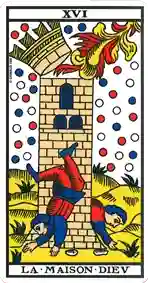
A tower of pale bricks, pierced by three windows, loses its crown under a flame coming from the upper right corner. Two figures fall or escape; the air is full of spheres in three colors. The engraved title is LA·MAISON·DIEV, “the House of God”; the usual English name, the Tower, comes from the Rider-Waite.
The crown flying off
- On the card
- The top of the tower, shaped like a crenellated crown, is lifted and tips to the left, separated from the body of the building.
- How it is read
- What falls is the top: the prestige, the summit, what had been placed above everything else. The tower itself holds; only its crown goes. The most accurate reading of the card lies there: a partial collapse, which knocks the top off more than it razes.
The flame from the corner
- On the card
- From the upper right corner comes a plume-shaped form, yellow, orange and blue, that touches the crown. No cloud, no drawn lightning bolt.
- How it is read
- People say “lightning,” but the drawing shows a flame or a feather of fire, with no cloud for it to come from. Some read it as a breath rather than a blow: what comes from above opens the tower more than it destroys it. The card is then read as a sudden revelation as much as an accident.
- Across editions
- Waite draws a real zigzag lightning bolt coming out of a black cloud, and a crown that leaps off in flames: the catastrophe version.
The 37 spheres
- On the card
- Thirty-seven round spheres float on both sides of the tower: 13 orange, 13 white, 11 blue, counted on this reproduction.
- How it is read
- Drops, hail, coins, sparks: the readings vary, and the number changes from deck to deck. What is constant is that they are scattered everywhere and come in three colors: what leaves the tower disperses into the air, in no particular direction. These spheres are read as the fragments of what held together, now free, neither good nor bad.
The two falling figures
- On the card
- One figure falls headfirst along the tower; the other, at its foot, is on all fours, head toward the ground. They wear the same colors, blue and red.
- How it is read
- Two ways out: falling or crawling. Neither is crushed; one even has his hands on the ground already. The card is less a catastrophe than a forced exit, and the hands set on the ground say the return to reality. Fallen from the top, they finally touch the yellow ground.
The three windows
- On the card
- An arched window at the top of the tower, two smaller windows side by side below it; no door.
- How it is read
- A tower with no door is read as a building you could neither enter nor leave: the top had to open. The blue windows say the inside was dark. The card’s question: what was this tower protecting you from, and at what price?
The Star: the eight stars, the two jugs and the bird
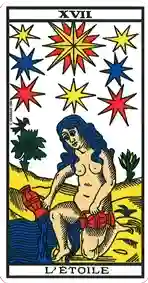
A naked woman, one knee on the ground, pours water from two red jugs, one into a river, the other onto the earth. Above her, a large sixteen-pointed star and seven smaller stars. A dark bird is perched on a tree.
The eight stars
- On the card
- A large central star and seven small ones around it: three yellow, two blue, two orange. All the small ones have eight points.
- How it is read
- Eight is the number most often read here: seven companion stars and one that guides. People see in them the ancient planets around a fixed star, or talents around a vocation. Keep the structure rather than the count: one main light, several secondary ones.
- Across editions
- Waite keeps one large yellow star and seven small ones, all eight-pointed, but the small ones are white. The alternating colors are specific to the Marseille.
The large sixteen-pointed star
- On the card
- The central star has sixteen points: eight long yellow ones and eight shorter orange ones, alternating.
- How it is read
- Two stars laid one over the other, one of light, the other of warmth. The large star is read as what gives direction: a clear bearing, visible from afar. Its two colors say it lights and warms at once. It is the fixed point of the card, the one the woman is not looking at.
The two jugs
- On the card
- Two red jugs: the one on the left pours into the blue water, the one on the right onto the yellow earth. Both pour at the same time.
- How it is read
- Giving to the water and giving to the earth: feeding what flows (emotion, the unconscious) and what carries (the real, the body). Nothing is held back: both jugs are tilted. The card is read as generosity without calculation, and as the gesture that regenerates after the Tower.
The nudity and the knee on the ground
- On the card
- The woman is naked, her blue hair loose, her left knee on the ground, her right foot flat. She looks down and to the left, toward the jug pouring into the water.
- How it is read
- The first full nudity in the deck, after the Fool’s tear and the Devil’s body: nothing left to protect. The knee on the ground is not submission, it is the position of someone working close to the ground. The card is read as truth without a mask, and the return to a simple gesture.
The bird on the tree
- On the card
- At the top left, a black bird, wings open, perched on a green shrub; a second bush grows on the right.
- How it is read
- Ibis, crow, phoenix: the readings differ, and the line does not settle it. What is certain: it is the only perched bird in the deck, and it is black on a pale card. It is read as a thought that has come to rest, or a messenger that waits. The green of the tree confirms that something is growing back.
The Moon: the towers, the dogs, the crayfish and the drops
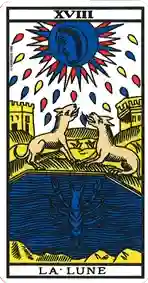
A moon in profile, turned to the left, shines above two yellow towers. Two dogs, rearing up, face each other with their mouths open. At the bottom, a blue crayfish in a pool. Nineteen drops fill the space between the moon and the dogs.
The crayfish
- On the card
- A blue crayfish, claws raised, fills the pool of blue water at the bottom of the card. It is drawn from above, as if seen through the water.
- How it is read
- What lives at the bottom and comes up: the crayfish is the image of the unconscious breaking the surface, of old memory, of the fear that rises at night. It walks backward, tradition says, hence the reading of going back over one’s steps. Astrologically, it recalls Cancer, the sign ruled by the Moon, a correspondence added after the fact but firmly established.
- Across editions
- Waite has his crayfish climb out of the water onto a path that leads between the towers: it advances. The Marseille’s stays in the pool.
The two dogs
- On the card
- Two similar flesh-colored animals, rearing up on their hind legs, face each other with their mouths open, heads raised toward the moon.
- How it is read
- “The dog and the wolf,” people often say: it was the Rider-Waite that drew a dog and a wolf. On the Marseille, they are two similar, indistinct beasts, howling together. They are read as the two voices of the night, tamed instinct and wild instinct, with no way of telling which is which. The fact that they are identical is the meaning: night does not let you tell them apart.
The nineteen drops, known as the “tears of the Moon”
- On the card
- Nineteen drops in three colors (8 blue, 6 orange, 5 yellow), their points turned toward the moon, spread between the moon and the dogs.
- How it is read
- It is often read that these drops rise toward the moon, which would be drawing up the dew of the earth, and that the Sun’s drops fall. In the drawing, the drops on both cards have the same shape and the same orientation, point toward the heavenly body: the difference is in the reading, not in the line. So keep both directions open: the moon receives what rises from the night, or lets its indirect light fall. The number 19 refers to the number of the Sun, which carries 13 drops; the two heavenly bodies answer each other.
The two towers
- On the card
- Two crenellated yellow towers at the edges of the card, the left one with two windows and a door, the right one with two windows and no door. Between them, hills, no path.
- How it is read
- The limits of the known world: beyond the towers, you can see no further. They are yellow, and so lit, but closed. The towers are read as the thresholds you hesitate to cross at night, and as what remains built when everything else goes blurry.
- Across editions
- Waite draws a path that passes between the towers and climbs toward mountains: the card becomes a journey. The Marseille offers no road.
The missing path
- On the card
- Between the dogs and the towers, yellow hills and a few tufts; no road, no passage marked toward the horizon.
- How it is read
- The most important detail the card lacks. Without a path, the Moon is not a stage to pass through but a state you find yourself in: night, blur, waiting. The question it asks is not “which way through” but “what do you see, and what do you think you see.”
The face in profile, turned to the left
- On the card
- Inside the blue disk, a face in profile, eyes lowered, looks to the left; a crescent edges the disk on the right.
- How it is read
- The moon looks neither at the reader nor at the scene: it looks elsewhere, toward the past by the convention. Its lowered eyes give the sky an air of reserve. This profile is read as a light that does not give itself head-on, and that lights everything beneath it at a slant.
The Sun: the two children, the wall and the drops
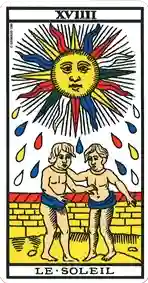
A sun with a human face, seen head-on, shines down on two naked children standing in front of a low wall of yellow bricks. Straight rays and wavy rays alternate; thirteen drops fall between the sun and the children.
The two children
- On the card
- Two naked children, in blue loincloths, stand side by side; the one on the right rests a hand on the other’s neck and looks at him; the one on the left answers with a hand on his belly and looks straight ahead.
- How it is read
- Twins, tradition says, hence the link with Gemini. They are read as a relationship between equals, cooperation, brother and sister, or the two parts of the self that recognize each other. The hand on the neck adds a note of care: one watches over the other.
- Across editions
- Waite replaces the two children with a single one, on a white horse, waving a red banner: the victory of one instead of the alliance of two.
The brick wall
- On the card
- Behind the children, a low wall of yellow bricks, with a red top edge, no higher than their waists.
- How it is read
- A wall too low to shut anyone in and high enough to mark a line: the healthy limit, the frame that protects without hiding. The children are in front of it, not behind it. The wall is read as what was built before them and keeps them warm, or as the boundary of a garden.
The thirteen drops
- On the card
- Thirteen drops, in four colors (5 blue, 3 yellow, 3 white, 2 orange), their points turned toward the sun, between the sun and the children.
- How it is read
- Light coming down into matter, a rain of blessings, warmth settling: the readings agree. Thirteen refers to Arcanum XIII, which has led some to say that the Sun brings back to life what XIII cut down; it is a reading by numbers, pleasing, not proven. The shape of the drops is the same as on the Moon; only the count differs.
The straight and wavy rays
- On the card
- Around the disk, thin, straight black rays alternate with colored rays, yellow, blue, orange, white and two green.
- How it is read
- Two kinds of light: the one that goes straight and the one that waves, brightness and warmth. Two discreet green rays signal the life that grows in this light. The alternation is read as the Sun’s double action: seeing clearly and feeling alive.
The face seen head-on
- On the card
- The yellow disk carries a human face, seen head-on, with open eyes, looking at the reader.
- How it is read
- Opposite the Moon in profile, the Sun looks you in the face: nothing hidden, nothing at a slant. It is read as the obvious, visible truth, clear consciousness. Along with Justice and the Devil, it is one of the cards that look at you.
Judgement: the trumpet, the angel and the figure seen from behind
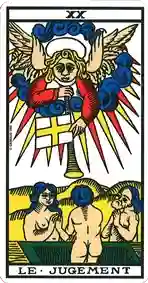
An angel comes out of blue clouds, surrounded by rays, and blows a trumpet from which hangs a banner with a cross. Below, three naked figures: a woman on the left, a man on the right, and between them a figure seen from behind who rises out of a green rectangle.
The trumpet and its banner
- On the card
- A long yellow trumpet, held vertical, bell downward; a white banner with a yellow cross is attached to it.
- How it is read
- The call you cannot fail to hear. The trumpet points at the figures: the sound comes down. The cross on the banner marks where the call comes from, without saying anything more about it. The card is read as a summons, a piece of news, an obvious fact that makes you get up.
The angel in the clouds
- On the card
- A haloed angel, with pale wings and yellow hair, emerges from curling blue clouds; yellow and orange rays spread out behind it.
- How it is read
- The third angel in the deck, after Temperance and the one in the World. It does not come down to land: it stays in the sky and speaks from there. It is read as what comes from somewhere other than yourself, a vocation, a message you did not write. The blue clouds say this message first passes through the inner world.
The figure seen from behind
- On the card
- In the center, a naked figure with blue hair, seen from behind, rises out of a green rectangle; the other two are looking at it.
- How it is read
- The only figure in the deck seen entirely from behind: the reader takes its place. It rises toward the angel; the other two, in profile, accompany it. This figure is read as the one who answers the call, or the one who is reborn before the eyes of their parents. Seen from behind, it has no face: it is you.
The green rectangle, known as the “tomb”
- On the card
- A green rectangle, flat on the ground, out of which the central figure rises to the waist.
- How it is read
- Tradition sees in it an open tomb: resurrection. The green, the color of growth, changes the meaning: what you come out of is also what makes things grow. The rectangle is read as the closed place you rise from, and its color as the promise that this place was not dead.
- Across editions
- Waite draws gray coffins floating on the water, with several bodies rising from them: the scene becomes collective and funereal.
The joined hands
- On the card
- The man on the right and the woman on the left both have their hands joined in front of them, at chest height.
- How it is read
- Prayer or welcome, both gestures say receiving: you do nothing, you receive. Beside the figure who rises, those around it stay turned toward it. These hands are read as the share of gratitude or recognition in every rebirth.
The World: the mandorla, the four living creatures, the wand and the vial
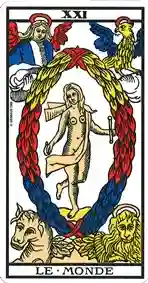
A naked woman, draped in a scarf, dances at the center of an oval wreath of yellow, red and blue leaves, tied at the top and the bottom. In the four corners, an angel, an eagle, a bull and a lion.
The mandorla and its three colors
- On the card
- An oval wreath of leaves, yellow at the top, red on the sides, blue at the base, surrounds the dancer. It is tied with a red ribbon at the top and the bottom.
- How it is read
- The almond shape (mandorla) is the frame of glorified figures in Romanesque art: what is at the center is accomplished. The three colors, from the yellow of light to the blue of depth, make this wreath a summary of the deck’s palette. The World is read as the completion where everything is in its place, and the mandorla as the passage to another scale. The glossary has an entry on the mandorla.
The two knots
- On the card
- At the top and the bottom of the wreath, a crossed red ribbon closes the oval, like a tie holding the leaves together.
- How it is read
- The wreath is tied, so closed, so finished: the cycle is complete. The red knots say this closing is an act, not a state. They are read as what has been concluded, and the effort it took to hold it.
The four living creatures
- On the card
- In the corners: a haloed angel at the top left, a haloed eagle at the top right, a bull without a halo at the bottom left, a haloed lion at the bottom right.
- How it is read
- The tetramorph, borrowed from Ezekiel’s vision and from Revelation, then from the four evangelists: Matthew (the man), John (the eagle), Luke (the bull), Mark (the lion). The occultists read in them the four elements and the four suits of the deck. What we keep are the four guardians of a complete space: the four directions, held together.
- Across editions
- Waite keeps the four living creatures in clouds; the Marseille sets them directly on the background, three haloed and the bull without a halo, on this reproduction.
The wand and the vial
- On the card
- The dancer holds a short wand in her left hand and, in her right, a small rounded object read as a vial.
- How it is read
- The Magician’s wand, held at the end of the road: the tool of the beginning, become a dance gesture. The vial holds what has been distilled. They are read as the two gains of accomplishment, acting and containing, reduced to their smallest form. Nothing else in the hands: the World has nothing left to carry.
The raised leg
- On the card
- The dancer stands on one leg, the other bent behind her, in the exact position of the Hanged Man’s legs, right side up.
- How it is read
- The Hanged Man turned over: what was suspended dances. The two cards, XII and XXI, are read through each other, and the Emperor (IIII) completes the series with his seated, crossed legs. The same structure is read as passing through three states: held, reversed, freed.
The scarf
- On the card
- A long pale scarf passes behind the neck, over the shoulder and in front of the pelvis, covering nothing else.
- How it is read
- The last garment, which hides nothing: the dancer is naked and veiled at once. The scarf is read as the share of modesty that remains in accomplishment, or as movement made visible: it floats because she dances.
The signs that run through the whole deck
Some details are not specific to one card: they come from the way the deck was engraved, numbered and colored. They turn up everywhere, and people often look for them without knowing they form a system.
IIII, VIIII, XIIII, XVIIII: the numerals written the old way
- On the card
- The Emperor carries IIII, the Hermit VIIII, Temperance XIIII, the Sun XVIIII. No subtractive form (IV, IX, XIV, XIX) anywhere in the deck.
- How it is read
- This is additive notation, common on clock faces and in engraving until the 18th century: easier to read at small size, easier to cut. A hidden meaning is sometimes attributed to it; nothing establishes one. It does, however, remind you that the numbers are a late addition to the drawing, and that they read as quantities, not as codes.
- Across editions
- The Rider-Waite (1909) writes IV, IX, XIV, XIX. Modern restorations of the Marseille keep the additive form.
LE·PENDV, LA·LVNE: the V in place of the U
- On the card
- The titles are written in Latin capitals: LE·PENDV, LA·LVNE, LA·MAISON·DIEV, LE·IVGEMENT, L’AMOVREVX, LA·ROVE·DE·FORTVNE.
- How it is read
- The classical Latin alphabet has no capital U or J: V and I stand in for them. It is an inscription convention, the same one you see on the pediments of buildings. It gives the titles an air of ancient epigraphy that has fed many “antique” readings of the tarot, without being proof of any.
The dots between the words of the titles
- On the card
- A middle dot separates the words: LE·MAT, LE·BATELEUR, LA·PAPESSE. Arcanum XIII has no title at all.
- How it is read
- Here again, it is the usage of Latin inscriptions. The one missing title, that of XIII, is a real choice: it is studied on its own in the article on the nameless card.
The yellow ground
- On the card
- Almost every card sets its figures on a wavy yellow ground, sometimes dotted with tufts of green. The exceptions are the cards with no visible ground (the High Priestess, Justice, the suspended Hanged Man, the Hermit, whose cloak touches the earth) and XIII, whose ground is black.
- How it is read
- Yellow is the color of what is lit and known: a yellow ground says the action takes place in broad daylight, on walkable terrain. The black ground of XIII and the blue water of the Moon are read by contrast.
The blue hair
- On the card
- The Hanged Man, Temperance, the Star, the three risen figures of Judgement, the two figures falling from the Tower and the crowned woman of the Lovers have blue hair. The sovereigns, the Magician, the Chariot, the Sun’s children, the Devil and the World have yellow or flesh-colored hair.
- How it is read
- Blue, in the deck’s palette, is the color of what is inner and received: water, sky, reflection. Blue hair is read as a thought turned inward, or a state of transition. Yellow, by contrast, marks light, action, clear consciousness. This color reading is consistent on the Conver lineage; it does not carry over to recolored decks.
- Across editions
- The 1930 Grimaud changed several colors, including some heads of hair; the Camoin-Jodorowsky (1997) restored others. Check your deck before reading a color.
The flesh color
- On the card
- Faces, hands and naked bodies (the Star, the Sun, Judgement, the World, the Devil and its imps) are a uniform beige, without shading. The Fool’s animal is this color.
- How it is read
- What is flesh-colored is alive and exposed: skin, what cannot be hidden. When an object or an animal takes this color, it can be read as a part of the figure rather than as an outside thing. It is the most debated key to the Fool’s animal.
Green, the rare color
- On the card
- Green appears on only 10 cards out of 22, always in small touches: the tufts on the Fool, the Magician, the Chariot, Temperance and the Tower, the bushes on the Star, two rays on the Sun, the tomb on Judgement, the crossbeam and the mounds on the Hanged Man, the trefoils on the Hierophant’s tiara.
- How it is read
- Green is the color of nature growing: wherever it appears, something living picks up again. Its absence on the Moon, XIII, the Devil or the World is not an oversight, it is information. This count holds for the Conver lineage; other editions are greener.
To the left or to the right: the direction of the gazes
- On the card
- The Magician, the Emperor, the Hermit, Temperance, the Star and the Moon look to the left; the Fool, Strength and XIII to the right; Justice, the Chariot, the Devil and the Sun look the reader in the face.
- How it is read
- A reading convention, widespread in the 20th century, puts the past on the left and the future on the right: a figure turned to the left looks back on what has been, a figure turned to the right commits. It is a tool, not a historical rule; the engravers probably never gave it a thought. But in a spread, it gives you one more sentence to lay over each card.
What a dictionary cannot tell you
A dictionary of symbols pins meanings down; a reading sets them moving again. The 124 entries on this page are starting points, not verdicts, and three precautions go with them.
The first: the meaning of a detail depends on the whole card and on the spread. The Moon’s two dogs do not say the same thing next to the Sun as they do next to the Devil. The dictionary gives the isolated meaning; the interpretation of a card puts it back in context.
The second: most readings have an author and a date. “The wolf and the dog,” “the Magician’s infinity sign,” “the Wheel’s sphinx” entered common usage through specific decks and books. Citing them is not invalidating them; it is knowing that another reading remains possible.
The third: what you see counts. A detail that stops you, even with no tradition behind it, is a legitimate way in, provided you name it as such: “what I see in it,” not “what it means.” In a session as in a personal reading, that distinction protects you from a good many of the stories people tell themselves.
What now
You have 124 details at hand, with their description, their reading and their variants. The simplest way to put them to work: draw a card, choose a single detail, and ask it the question it suggests before reading anything else.
If you cite this page in a class or an article, link straight to the detail’s anchor: every entry has its own, and the counts state which edition they come from.
About the author
Stéphane Gamot — Founder of TarotNova, web application engineer. A Tarot de Marseille enthusiast since childhood, he treats it as a tool for asking questions, never as a tool for prediction, and builds the site's tools himself.
Published on September 26, 2026 · updated on September 26, 2026
Share this dictionary
Frequently asked questions
How many symbols are there in the Tarot de Marseille?
There is no official number: it all depends on what you call a symbol. This page lists 124 across the 22 major arcana, keeping only the drawn details that an interpretive tradition has taken up. The 56 minor arcana add more, especially in the court cards (pages, knights, queens, kings).
Is the Fool’s animal a dog?
On the Conver lineage, it is a flesh-colored animal with no recognizable species, clawing at the Fool’s thigh. Custom calls it a “dog,” and the Rider-Waite makes it a small white dog. Some see a cat or a lynx. What matters is its gesture: it clings to the traveler and tears his breeches.
Why are the numerals written IIII and VIIII?
It is additive Roman notation, usual among engravers and clockmakers until the 18th century, simpler to cut in wood and to read at small size. The Rider-Waite adopts IV and IX. No hidden meaning has been demonstrated behind this way of writing.
Are the symbols of the Tarot de Marseille the same as those of the Rider-Waite?
No. The Rider-Waite (1909) redrew all 78 cards: it adds an infinity sign above the Magician, a wolf and a path to the Moon, a horse to the Sun, and swaps Justice (8) and Strength (11). Many common readings come from it and do not match the Marseille drawing.
How many drops, or tears, are there on the Moon and on the Sun?
On the Conver-type reproduction used here, 19 drops on the Moon (8 blue, 6 orange, 5 yellow) and 13 on the Sun (5 blue, 3 yellow, 3 white, 2 orange). On both cards, the drops point toward the heavenly body. Other editions give other numbers.
Do you need to know every symbol to read tarot?
No. A spread is read with a few well-observed details, not with a catalog. The dictionary is for when a detail stops you and you want to know what has been said about it before you. After that, the question asked and the context of the spread decide.
Related articles
Meaning of the 22 major arcana of Tarot de Marseille
A major reference guide to understand the 22 major trumps, their symbolic logic, their role in spreads and their main dynamics.
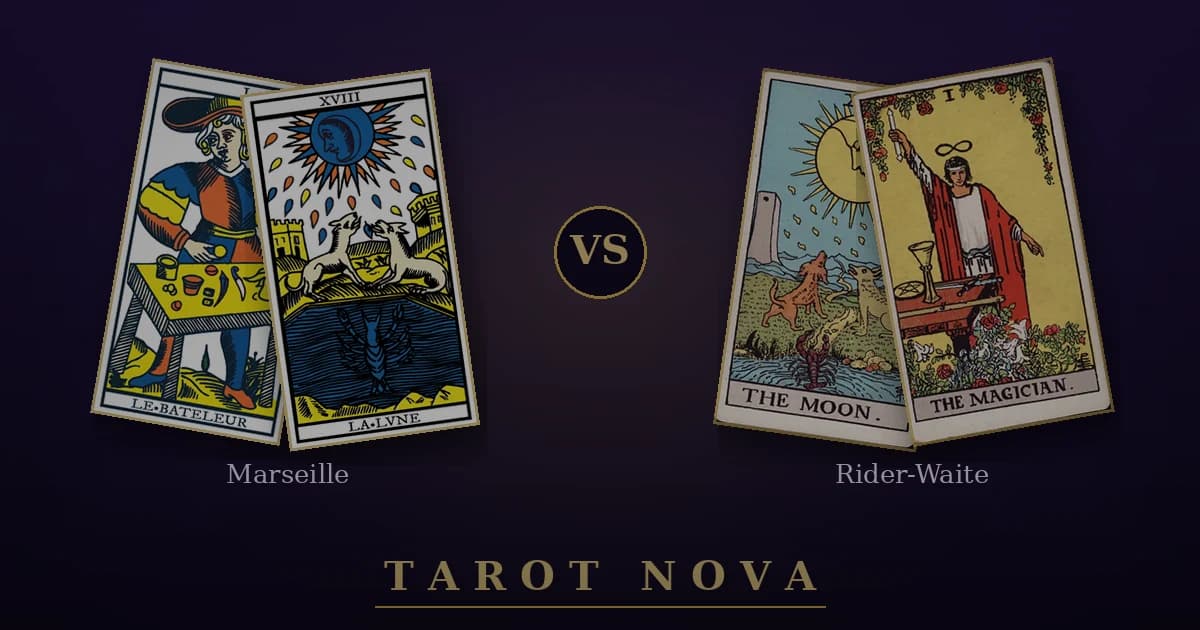
Marseille Tarot vs Rider-Waite: which one to choose?
Origins, key differences, a comparison table and advice by profile to choose between the two great tarot decks — with our admitted soft spot for Marseille.
Why tarot card XIII has no name
The only numbered card of the Tarot de Marseille with an empty title banner, arcanum XIII has intrigued readers since the 17th century. Historical theories, imagery, true meaning — and why it does not foretell death.