
Comparatif
Tarot de Marseille vs Rider-Waite : lequel choisir ?
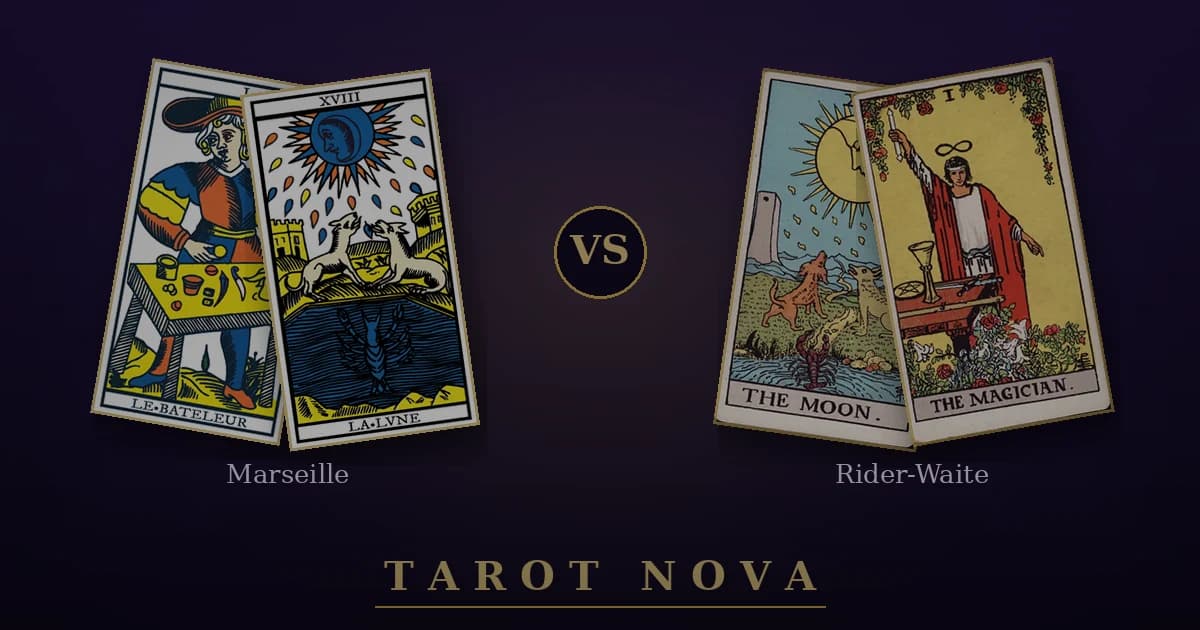
C’est sans doute la question que se pose tout débutant : par quel jeu commencer ? Le Tarot de Marseille et le Rider-Waite sont les deux références mondiales, et le choix entre les deux peut sembler intimidant.
Bonne nouvelle : il n’y a pas de mauvais choix. Ces deux jeux ne sont pas des rivaux, mais deux langages différents issus d’une même famille. Chacun a sa logique, son esthétique et sa façon de se laisser lire.
Dans cet article, tu trouveras leurs origines, leurs vraies différences, un tableau récapitulatif clair, et une recommandation selon ton profil pour t’aider à choisir en confiance.
Deux jeux, deux histoires
Le Tarot de Marseille plonge ses racines dans l’Europe des XVIIe et XVIIIe siècles. Imprimé à la gravure sur bois, aux couleurs franches, il s’est fixé à travers de grands cartiers comme Jean Noblet ou Nicolas Conver. Il constitue le cœur historique du tarot occidental et reste la référence de la tradition française et européenne.
Le Rider-Waite, lui, naît en 1909 : conçu par l’occultiste Arthur Edward Waite et illustré par Pamela Colman Smith, publié par l’éditeur Rider & Co à Londres. C’est aujourd’hui le jeu le plus répandu dans le monde, en particulier dans les pays anglophones, et la base de l’immense majorité des jeux modernes.
Les deux descendent d’une même grande famille symbolique, mais ils ont divergé : non seulement dans leurs images, mais aussi dans leur manière même d’être lus. C’est cette divergence qu’il faut comprendre pour choisir.
Les différences qui comptent vraiment
Au-delà du style, voici les distinctions qui changent concrètement votre façon de pratiquer.
Les arcanes mineurs
C’est la différence la plus décisive. Le Rider-Waite illustre ses 56 arcanes mineurs par des scènes complètes : on peut littéralement « lire » l’image. Le Tarot de Marseille, lui, garde des mineurs dits « pip » : des arrangements de coupes, deniers, épées et bâtons, sans scène figurative. Lire les mineurs du Marseille demande donc une connaissance des nombres et des enseignes.
Le style visuel
Le Marseille offre une esthétique médiévale, hiératique, aux aplats de couleur tranchés. Le Rider-Waite propose une illustration narrative, d’inspiration symboliste victorienne, plus douce et immédiatement évocatrice.
L’inversion VIII / XI
Détail important : dans le Marseille, la lame VIII est la Justice et la XI est la Force. Waite a inversé les deux (8 = la Force, 11 = la Justice) pour les aligner sur des correspondances astrologiques. Mieux vaut le savoir quand on passe d’un jeu à l’autre.
La philosophie de lecture
Le Marseille invite à une lecture symbolique et structurelle : on s’appuie sur le nombre, l’enseigne, la place dans le jeu. Le Rider-Waite favorise une lecture narrative et intuitive, portée par la scène représentée.
L’écosystème et les ressources
Le Rider-Waite bénéficie d’une immense quantité de livres et d’applications, surtout en anglais. Le Marseille s’appuie sur une tradition française et européenne riche, plutôt orientée vers l’étude approfondie.
Tableau comparatif
Une vue d’ensemble des deux jeux, côte à côte.
| Critère | Tarot de Marseille | Rider-Waite |
|---|---|---|
| Origine | Europe, XVIIe–XVIIIe s. | Angleterre, 1909 |
| Style visuel | Gravure médiévale, couleurs franches | Illustration narrative, symbolisme victorien |
| Arcanes mineurs | Lames « pip » (motifs d’enseigne) | 56 mineurs entièrement illustrés |
| Lames VIII et XI | VIII = Justice, XI = Force | 8 = Force, 11 = Justice |
| Lecture | Symbolique et structurelle | Narrative et intuitive |
| Courbe d’apprentissage | Progressive, demande de l’étude | Accessible dès le début |
| Idéal pour | L’étude approfondie et la tradition | Débuter et lire intuitivement |
Lequel choisir selon votre profil
Plutôt que de chercher « le meilleur » jeu dans l’absolu, demandez-vous lequel correspond à votre façon d’aborder le tarot.
Vous débutez et voulez lire rapidement
Rider-Waite. Les scènes illustrées des 56 mineurs guident l’intuition et permettent de se lancer sans connaissances préalables.
Vous aimez le symbole, l’histoire, la profondeur
Tarot de Marseille. Sa logique symbolique récompense l’étude et ouvre une lecture d’une grande richesse.
Vous êtes analytique et aimez la structure
Tarot de Marseille. Les nombres et les enseignes offrent un cadre rigoureux et cohérent.
Vous lisez surtout l’amour et le quotidien de façon imagée
Rider-Waite. Les scènes parlent d’elles-mêmes et facilitent une lecture vivante et concrète.
Vous voulez ancrer une pratique durable et exigeante
Tarot de Marseille. C’est un compagnon d’étude pour des années, qui se révèle peu à peu.
Chez Tarot Nova, nous avons un faible assumé pour le Tarot de Marseille : une fois sa logique symbolique apprivoisée, il offre une profondeur de lecture incomparable. Mais soyons honnêtes — le meilleur jeu reste celui avec lequel vous avez envie de pratiquer chaque jour.
À retenir
- Les deux jeux descendent de la même famille mais parlent deux langages différents.
- Le Rider-Waite illustre ses 56 mineurs : idéal pour une lecture intuitive et rapide.
- Le Tarot de Marseille demande plus d’étude, mais offre une profondeur symbolique unique.
- Attention à l’inversion VIII / XI (Justice et Force) entre les deux traditions.
- Le meilleur jeu est celui qui vous donne envie de pratiquer — avec, pour nous, un faible pour Marseille.
Articles liés
Questions fréquentes
Quel tarot choisir quand on débute ?
Le Rider-Waite est souvent conseillé aux débutants, car ses 56 arcanes mineurs sont illustrés par des scènes qui guident l’intuition. Cela dit, le Tarot de Marseille reste un excellent choix si vous aimez étudier la symbolique. Le bon jeu est avant tout celui qui vous attire visuellement.
Quelle est la principale différence entre Marseille et Rider-Waite ?
La plus décisive concerne les arcanes mineurs : entièrement illustrés en scènes dans le Rider-Waite, réduits à des motifs d’enseigne (cartes « pip ») dans le Marseille. Le style visuel et la philosophie de lecture diffèrent également.
Pourquoi la Force et la Justice sont-elles inversées ?
Dans le Tarot de Marseille, VIII correspond à la Justice et XI à la Force. Arthur Edward Waite a inversé ces deux lames (8 = la Force, 11 = la Justice) pour les aligner sur des correspondances astrologiques. C’est une différence utile à connaître quand on passe d’un jeu à l’autre.
Le Tarot de Marseille est-il plus difficile ?
Il demande davantage d’étude, car ses arcanes mineurs ne sont pas illustrés par des scènes. Mais cette exigence est aussi sa richesse : elle pousse à comprendre la structure et la symbolique plutôt qu’à se fier à une seule image.
Peut-on apprendre les deux jeux ?
Oui, et beaucoup de praticiens le font. Commencer par l’un n’empêche pas d’explorer l’autre ensuite. Les deux traditions s’éclairent et s’enrichissent mutuellement.
Lequel est le plus utilisé ?
Le Rider-Waite est le jeu le plus répandu dans le monde, surtout dans les pays anglophones. Le Tarot de Marseille domine la tradition française et européenne, et reste la référence pour l’étude symbolique.
Articles liés
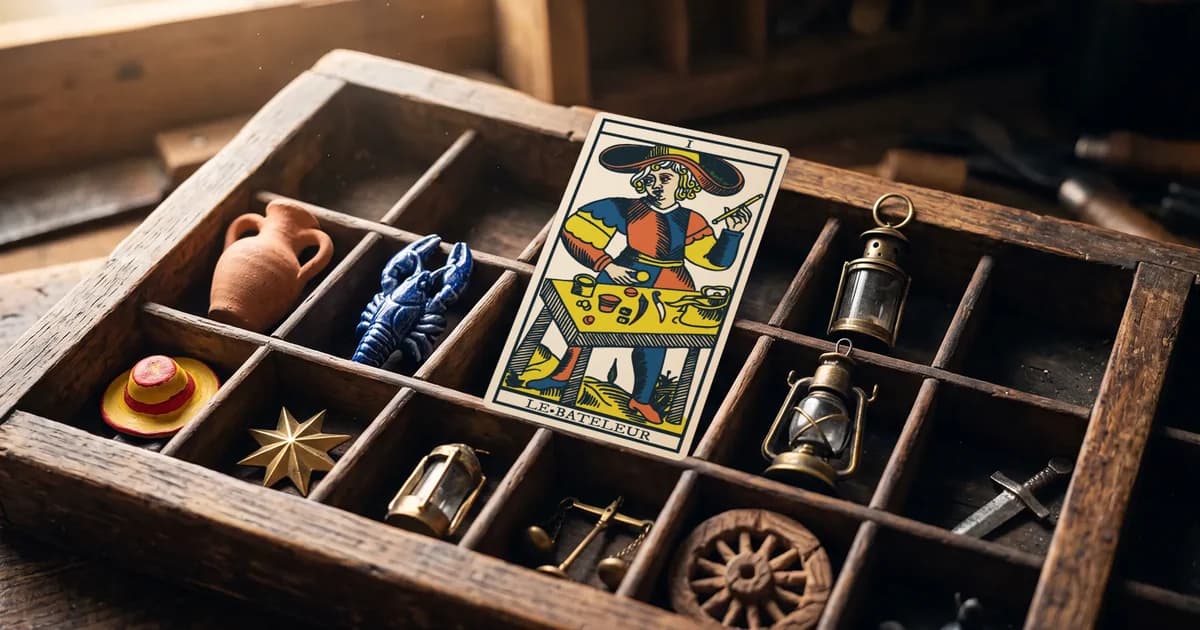
Dictionnaire illustré des symboles du Tarot de Marseille : 124 détails, lame par lame
Le chien du Mat, le chapeau du Bateleur, les 19 gouttes de la Lune, les 37 boules de la Maison Dieu : 124 détails des 22 arcanes majeurs, avec ce qui est dessiné, ce que la tradition y lit et ce qui change d’une édition à l’autre.
Que veut dire une carte tirée à l’envers ? Le guide complet
Une carte inversée n’est pas la « version négative » d’une lame : les deux écoles d’interprétation, les 5 logiques d’inversion (blocage, intériorisation, excès, déclin, libération) et des exemples concrets pour lire sans s’inquiéter.

Votre carte de naissance au tarot : calculer son arcane de personnalité et son arcane d’âme
Une date de naissance donne deux arcanes majeurs. Calculez les vôtres en trente secondes, lisez les 22 profils, et apprenez pourquoi un Tarot de Marseille ne donne pas la même lame qu’un calculateur anglophone pour un 8 ou un 11.