
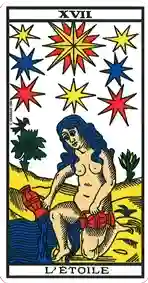
What does a card drawn upside down mean?
When a card appears upside down in a spread, many beginners immediately read it as a bad omen. Yet a reversed card is never simply the “opposite” or the “negative version” of an upright one. It describes the same energy, but expressed in a different way: held back, turned inward, exaggerated or in the midst of transformation.
Learning to read reversed cards means learning to perceive the nuances of a spread. But first you need to decide whether you want to use them at all, and according to which logic: there are in fact several schools, and none is more “true” than the others.
The key point: a reversed card keeps the theme of the upright card — what changes is the way it expresses itself. Not a bad omen, but a nuance.
What is a reversed card?
A card is said to be “reversed” (or “inverted”) when it appears in the spread with its image facing downward, that is, upside down from the reader’s point of view. This happens naturally when the deck has been shuffled and some cards have rotated.
Contrary to a widespread belief, reversal does not turn a “positive” card into a “negative” one. It changes the way the card’s energy expresses itself, not its deeper nature. The arcanum keeps its central theme: it is its dynamic that shifts.
You can compare a card to a musical note. Reversed, it is the same note, but played lower, muffled, or on the contrary saturated. The meaning remains recognizable; it is the color that moves.
Should you really read cards upside down?
This is the first question to ask, and the answer depends on your practice. Two schools coexist.
The approach that does not use reversals
Many readers, particularly in the Marseille Tarot tradition, choose to always read cards upright. For them, each arcanum already contains its share of shadow and light: the context of the spread and the neighboring cards are enough to reveal whether the energy is favorable or hindered.
The approach that uses reversals
Other readers, often in the Rider-Waite tradition, see reversal as valuable additional information. It makes it possible to distinguish a fully available energy from one that is blocked, emerging or declining.
Neither is superior. What matters is to choose one rule and stick to it within a single spread: deciding in advance whether reversals count avoids confused interpretations.
The main ways to interpret a reversal
Rather than memorizing a reversed meaning for each of the 78 cards, it is far more effective to understand the few logics that govern reversal. A reversed card almost always signals one of these dynamics.
Blockage or delay
The card’s energy exists but does not flow freely: an opportunity is delayed, a momentum is held back, a decision remains pending.
Internalization
What was expressed outwardly is now lived within: a card of action becomes reflection, a card of relationship becomes introspection.
Excess or imbalance
The energy is present, but too much so: strength becomes authoritarianism, generosity becomes self-sacrifice, caution becomes fear.
Decline or the end of a cycle
The card’s energy is running out or coming to an end, making room for something else.
Release
For traditionally difficult cards, reversal can on the contrary announce a way out of crisis: the tension eases, the weight lifts.
A good reading does not consist of mechanically applying one of these frameworks, but of choosing the one that resonates with the question asked and the rest of the spread.
Concrete examples of reversed arcana
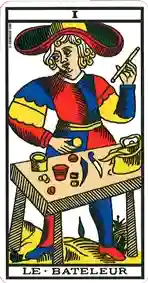
The Magician reversed
Upright, it evokes beginnings, initiative and confidence in one’s abilities. Reversed, it can signal a hesitation to get started, a project that struggles to take off, or a lack of preparation. The energy of momentum is there, but it has not yet found its footing.
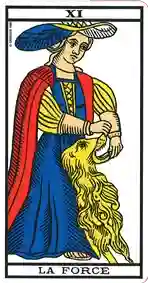
Strength reversed
Upright, it speaks of gentle mastery and quiet courage. Reversed, it can indicate doubt about one’s own abilities, energy that is poorly channeled, or on the contrary a dominance exercised with harshness rather than with calm.
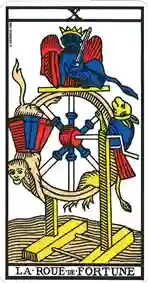
The Wheel of Fortune reversed
Upright, it announces a change, a turning point. Reversed, it can suggest a period of stagnation, a resistance to change, or a cycle closing before another opens.
In each case, the central theme of the card remains — reversal merely shifts its expression.
Marseille Tarot and Rider-Waite: two approaches
The importance given to reversals is not the same depending on the deck.
The Marseille Tarot traditionally favors upright reading. Its symbolic richness — colors, gestures, directions of gaze — already allows the nuances to be grasped without resorting to reversal. Many Marseille readers never turn their cards.
The Rider-Waite, designed with illustrated scenes on every card, lends itself more readily to reversed reading: a turned image visibly changes the “reading” of the scene, which makes reversal more intuitive.
To go further, see our comparison Marseille Tarot vs Rider-Waite.
How to progress without overcomplicating things
- Start by reading all your cards upright while you master the basic meaning of each arcanum.
- Introduce reversals only once you feel comfortable, and decide in advance whether they count in a given spread.
- Rather than memorizing 78 reversed meanings, remember the five logics of reversal: blockage, internalization, excess, decline, release.
- Always look at the reversed card in relation to its neighbors: it is the spread as a whole that reveals whether the energy is held back or simply in transformation.
With practice, reversal stops being a source of worry and becomes an additional tool for precision.
Read next: how to interpret a tarot card and tarot symbolism.
Frequently asked questions
Is a reversed card always negative?
No. Reversal does not make a card “bad.” It indicates that its energy is expressed differently: held back, turned inward, in excess or in transformation. Some difficult cards even become gentler once reversed.
Do I have to read cards upside down?
Not at all. Many readers, especially with the Marseille Tarot, always read upright and rely on the context of the spread. What matters is to choose a method and stick to it.
How does a card end up reversed?
Naturally, during the shuffle: some cards rotate. If you do not want to use reversals, you simply need to put all the cards facing the same way before drawing.
Do I need to memorize a reversed meaning for each card?
That is not necessary. It is more effective to understand the main logics of reversal and apply them to the theme of each arcanum.
Do reversals mean the same thing in the Marseille Tarot and the Rider-Waite?
The principle is similar, but the Rider-Waite, with its illustrated scenes, lends itself more readily to reversed reading, whereas the Marseille often favors upright reading.
Related articles
How to interpret a tarot card
Learn how to read a card with method, context and coherence, without falling into automatic keywords.
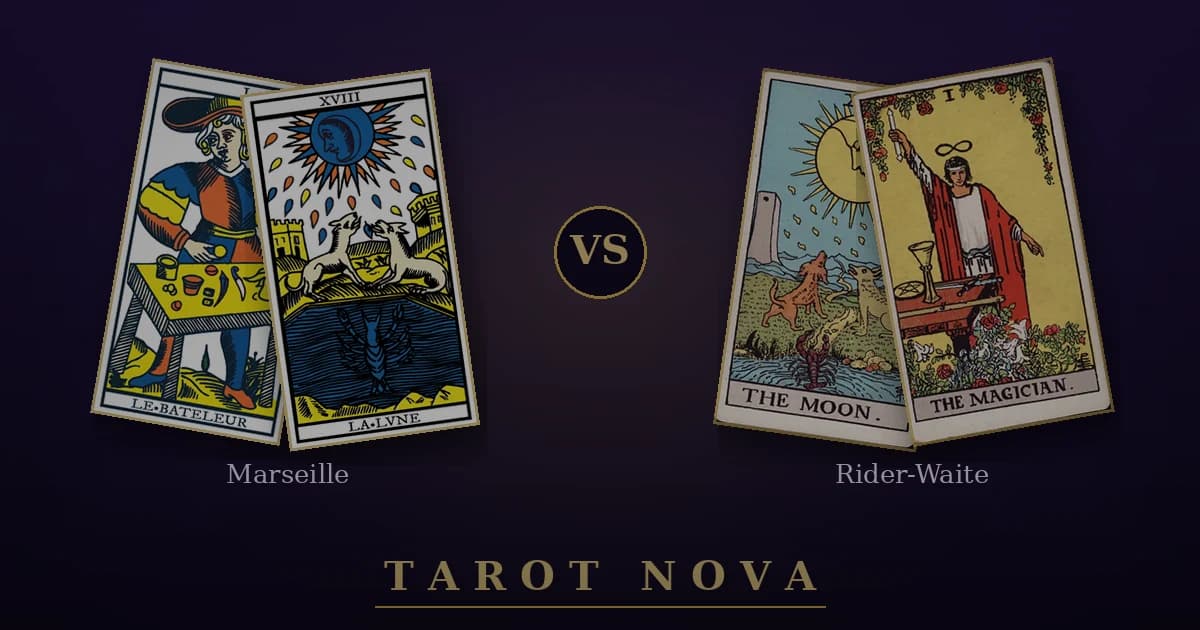
Marseille Tarot vs Rider-Waite: which one to choose?
Origins, key differences, a comparison table and advice by profile to choose between the two great tarot decks — with our admitted soft spot for Marseille.
What your favorite tarot card reveals about your personality
One card always pulls at us more than the others, and that little crush is rarely a coincidence. Personality portraits of 8 major arcana, to read as a mirror — not a verdict.