
Seasonal spread · September
The back-to-school tarot spread: five cards to find your footing in September
Two returns happen in the same September week. The one with backpacks, supply lists and timetables pinned to the fridge. And the quieter one, where adults reopen a laptop in front of eight hundred emails and a kick-off meeting. They have more in common than we admit: in both cases something you put down has to be picked back up, and you have to decide how fast.
Tarot has nothing to say about the content of your term. It does not announce success or failure, and no card will ever decide a course of study or a resignation. What it does well is give a readable shape to a confusing moment: it puts images on what is restarting, on what already weighs, and on the pace you are about to adopt without thinking it through.
This article offers a five-card September spread, the six major arcana that speak best about starting again, three ways to read depending on the return you are living, and the only appointment that really matters: mid-October, when September's momentum drops.
Why September works like a second New Year
In countries built around a school calendar, the real calendar of adults never quite left the classroom. We keep counting years in terms and returns long after handing in our last assignment. September is the only moment besides January when changing something needs no justification: nobody raises an eyebrow at a new habit started on the first Monday of the month.
The difference with New Year is worth noticing. The first of January arrives after a long break, in a mood of stocktaking, and loads resolutions with a solemnity that makes them fragile. September restarts while already walking: the structure exists — timetables, teams, classes, deadlines — and you only have to take your place in it. September intentions often hold better than January ones, for a simple reason: they lean on a frame instead of having to invent one.
That is exactly a spread's territory. Where January calls for promises, September calls for adjustments — and adjustment is precisely what tarot illuminates. The question is not "what will I become this year" but "what am I picking back up, and with what".
The adult return exists too
We talk endlessly about the school year and almost never about the office one, though it concerns far more people. Coming back from leave, reshuffled teams, budgets restarting, last-quarter targets: the professional return has its own anxieties, rarely voiced, and often heavier than a stationery list.
What a September spread can do — and what it cannot
A back-to-school spread does not predict the year. It does not say whether exams will be passed, whether the raise will come, whether the new team will work. Any reading that promises this steps outside what the images can actually do: describe a present dynamic, with its strengths and its points of tension.
What a spread does well in September comes down to three things. It forces you to name what is restarting — a rare exercise, because a return is endured more often than decided. It surfaces the load you had chosen to ignore, the one that is not in the calendar but will occupy your Sunday evenings. And it raises the question of pace, the only one that decides whether any of this still stands in November.
Otherwise the usual rule applies: you read your own situation, not someone else's, and a difficult card describes an effort to make, never a sentence. If you are starting out, the basic method is covered in our guide to reading the cards for yourself
The five restarts spread, position by position
Five cards, laid in a line from left to right. Shuffle while holding a plainly worded question about starting again — not a question about the future. Turn all five at once, then read them in order: each position answers a precise question, and it is the sequence of five that makes the reading.
- Card 1
What I put down
What summer ends with: a tiredness, a parenthesis, an idea you had in July that now has to be filed away or held on to.
The position's question: what am I leaving behind as I start again?
- Card 2
What I pick back up
The real thread of the return — rarely the announced one. This card describes what actually restarts, underneath the stated intentions.
The position's question: what is concretely starting up again this time?
- Card 3
What weighs
September's invisible load: logistics, enrolments, the inbox of the return, the comparison with everyone else.
The position's question: what will cost me more than I expect?
- Card 4
My resource
What you can count on and systematically forget to count: a skill, a person, a frame, a habit already in place.
The position's question: what can I genuinely lean on?
- Card 5
The right pace
The most useful card in the spread, and the one everyone skips: the speed at which this return can hold until December.
The position's question: at what cadence do I go the distance?
How to connect the five cards
Read the 2–3 pair first: what restarts, and what weighs. That is the heart of the spread, and often the tension of the whole term. Then check whether card 4 — the resource — actually answers the load of card 3; when it does not, the return leans on a strength that does not help where it hurts. Finish with card 5, which sets the pace: a slow card behind four fast ones is a more useful warning than any prediction.
You can lay this spread with a physical deck or online. Two shorter formats also suit the first weeks:
Six arcana that speak about starting again
No card is "the back-to-school card". But six major arcana describe the ways of starting again particularly well, and turn up often in September spreads. Here is what each one says — and the misreading that shadows it.
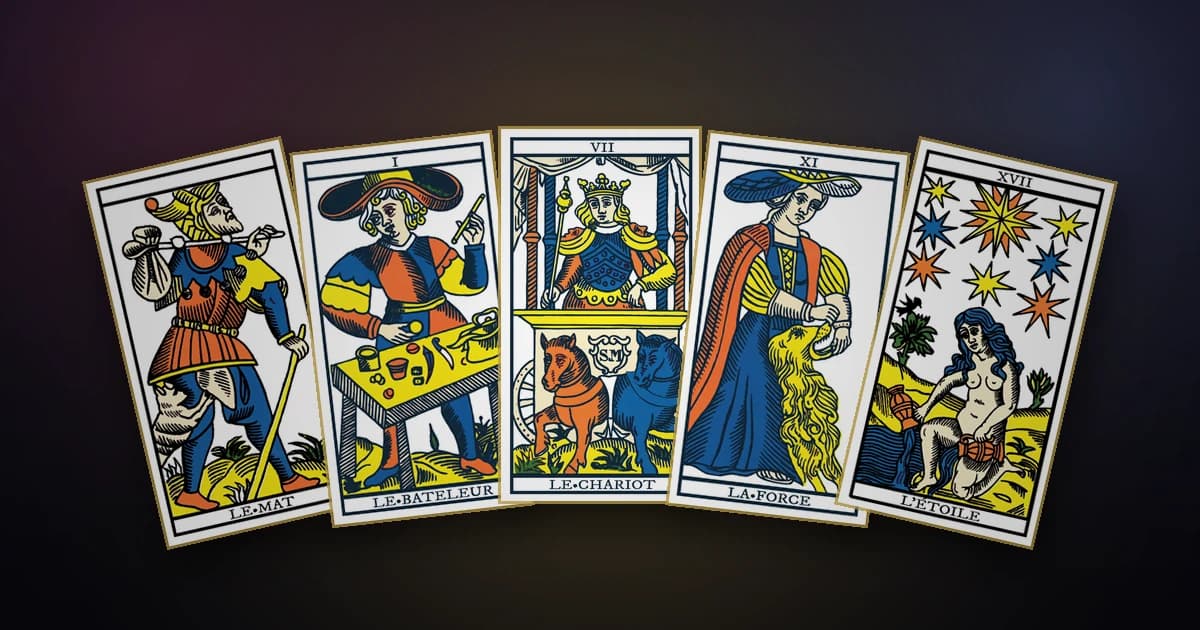
The Fool — momentum without a plan
It describes a return that refuses to be planned: a change of air, an urge to leave, a refusal of boxes. In a restart position it often signals that the essential part of the year will not appear in September's calendar.
The trap: mistaking freedom for the absence of a decision. The Fool walks; he does not drift.
The Magician — the desk on day one
Every tool is laid out, nothing is committed yet. This is the first-day card: the equipment, the possibilities, the available skill. It invites you to start small and for real.
The trap: staying in front of the table. A Magician who prepares indefinitely never begins.
The Chariot — getting under way
The team of horses moves off. The Chariot speaks of momentum, visibility, the ability to steer several directions at once — the return that starts fast and is happily shown off.
The trap: leaving quickly without knowing where. Two horses pulling opposite ways is September with three simultaneous projects.
Strength — holding over time
A hand opens the lion's jaws without violence. This is the card of constancy: what holds through regularity rather than spectacular effort. In September it speaks of the long run more than of the first week.
The trap: taking strength for willpower. Nothing is forced here: it is maintained.
The Hermit — the inner pace
He walks slowly, lighting only the ground in front of him. Drawn in the pace position, this card advises a quieter return: fewer commitments, more depth, a restart that does not try to match anyone else's.
The trap: confusing withdrawal with isolation. The Hermit holds a lamp: he lights the way for those behind him too.
The Star — the year's horizon
She pours her jugs without counting, at night, with no audience. This is the card of the gesture that continues after September — the one that best answers "why am I starting again".
The trap: expecting a visible result straight away. The Star irrigates; she does not harvest.
The other cards are not off topic either: the Empress speaks well of a return spent creating, the Pope of going back to study, Temperance of a gradual return after time away. Each arcanum is detailed in our guide to the 22 major arcana
Three returns, three ways to read
Back to school — and the parents' return
For a student, the spread reads mostly on cards 2 and 5: what is actually restarting (a course chosen? endured? taken for lack of better?) and at what pace it is sustainable. The third card, the load, often says something about comparison with others, which is the real fatigue of the first weeks.
For a parent, the spread changes object. You do not read your child's schooling — that is their life, not yours — but your own position: what you carry of this return, what you project onto it, what you could set down. The fourth card is often the most telling: it names the support you forget to ask for.
Going back to work after the break
The professional return has one peculiarity: it grants a brief, precious lucidity. For about ten days you see clearly what is wrong with your job — then habit closes the window. A spread laid during that window keeps a trace of what you saw, which is exactly what you will no longer be able to articulate in November.
Read the 3–4 pair first: the load and the resource. If the load is structural while the resource is personal, the imbalance has a name — and that is already a great deal.
The return of those who are changing
Career change, returning after a long absence, starting a business, going back into employment: these returns come with no ready-made frame. The structure does not pre-exist, it has to be built — which is what makes them as exhausting as they are exciting.
Here card 1 becomes central: what you put down defines what you can take up. And card 5, the pace, stops being an organisational detail and becomes the condition for the project's survival.
Two articles extend these readings:
Five September questions that work (and five that fail)
The quality of a back-to-school spread is settled before the shuffle. A closed question about the future produces a sterile reading; an open question about dynamics produces a reading you can use the next morning.
Five that work
- What is this return really asking me to pick back up?
- What is the actual dynamic of my work since I came back?
- What in my current setup will not hold until December?
- Which resource already in place can I lean on this term?
- What am I continuing out of habit rather than choice?
Five that fail
- Is my year going to go well?
- Am I going to pass my exams?
- Will I get a raise this year?
- Should I resign?
- What does my manager think of me?
They fail for the same reason: they ask for a verdict on future facts, or on what is happening inside someone else's head. Rephrased as "what is the dynamic of…", they become readable again.
The full method for phrasing them, with examples sorted by theme, is in our article on questions to ask the tarot
The real appointment: mid-October
September is easy. The return carries its own momentum: everything is new, the calendar is still theoretical, the energy holds by itself. The truth arrives around mid-October — when the first deadlines land, the days shorten noticeably, and the pace chosen in September shows whether it held.
Hence the only discipline this spread asks for: write your five cards down somewhere, with the date, in three lines. Then reread them six weeks later, without drawing again. The fifth card, the one about pace, becomes striking at that moment: either you kept the speed it indicated, or you see precisely where you lost it.
That is where tarot stops being a consultation and becomes a practice: not an answer received in September, but a question asked again in October, with the same images and six weeks of reality added.
Key points
- September works like a second New Year: a calendar marker that permits a restart, without January's symbolic pressure.
- A back-to-school spread does not announce the year; it describes what restarts, what weighs, and at what speed it can hold.
- Five positions are enough: what I put down, what I pick back up, what weighs, my resource, the right pace.
- The fifth card — pace — is the one everyone skips and the one that decides what follows.
- School and work returns raise the same underlying question: what are we picking back up, and with what?
- The real appointment is not in September but in mid-October, when momentum drops: that is when you reread your spread.
Frequently asked questions about the September spread
When should I lay a back-to-school spread?
The best moment sits between the last week of August and mid-September, once the return has begun but before the rhythm closes in. Too early and you read an imaginary return; too late and you read a routine already installed that you no longer question.
Do I need a different spread for school and for work?
No. Both returns raise the same underlying question: what are we picking back up, at what pace, with what resources? The five restarts spread works for both; only the wording of the question changes, and that is what orients the reading.
Can I lay a back-to-school spread for my child?
It is better not to read for someone who has not asked, a child included. You can, however, read your own position as a parent: what you carry of this return, what you project onto it, what you could lighten. The spread then lights up your stance, not your child's schooling.
How many cards for a September spread?
Five is plenty. Three cards give a quick reading but leave out the question of pace, which is precisely September's weak point. Beyond seven, the reading dilutes and the spread becomes a memory exercise rather than an aid to decision.
Can tarot tell me whether my school or work year will be good?
No, and that is a good thing: a year is not decided in a spread. Tarot highlights the dynamic of the moment — what is pushing, what is slowing, what can be leaned on. The rest depends on decisions and circumstances no card determines.
What if the September spread turns up difficult cards?
So-called difficult cards describe an effort, not a punishment. The Tower in the load position often signals an organisation that no longer holds; the Nameless Arcanum, something that needs to end before anything restarts. These are method indications, not omens: they say where to place your attention in September.
Related articles
Tarot and career change: 7 cards to watch
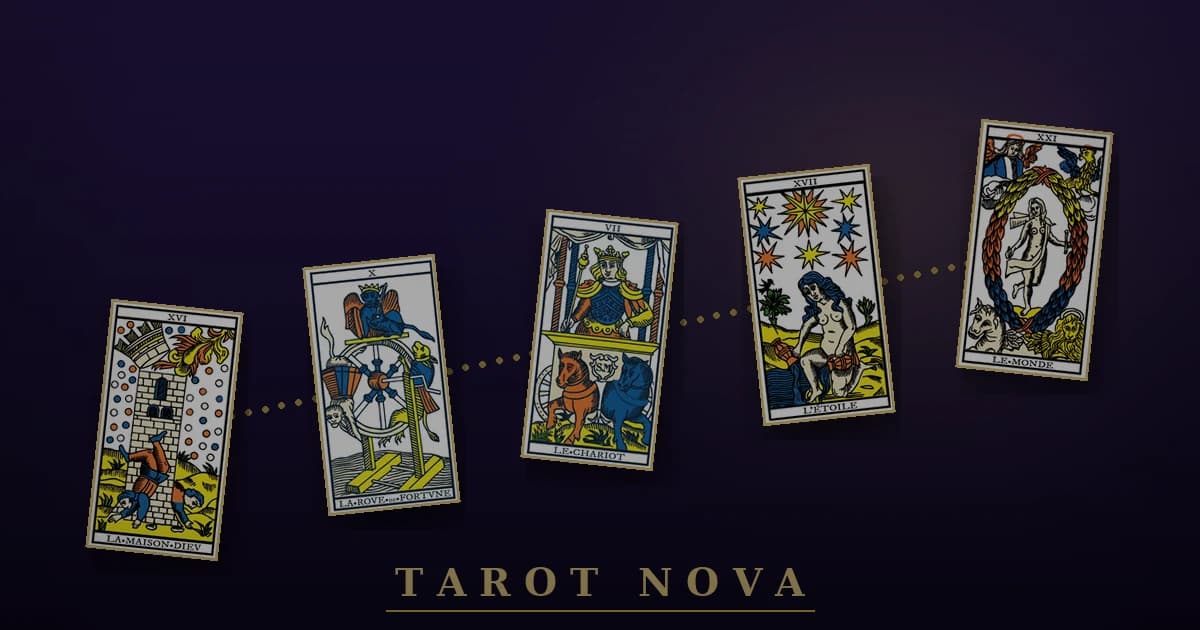
From the Tower to the World, the 7 arcana that mark a career change — what they indicate, each card's advice and a dedicated spread to move forward.
200 examples of questions to ask the tarot
Human, concrete and varied examples to better formulate your questions about love, work, decisions and personal growth.

How to read tarot cards for yourself
A serious method for practicing tarot for yourself with more distance, structure and lucidity.